Hey all,
Please bear with me. I’m making some updates to my website.
Lots of things brewing and exciting stuff to come soon.
Thanks and check back.
Bill
Hey all,
Please bear with me. I’m making some updates to my website.
Lots of things brewing and exciting stuff to come soon.
Thanks and check back.
Bill

Patient: “I feel great!”
[Long pause… furrowed brow]
Patient: “What do I do now?”
Bill: “Establish a foundation of resilience, and then build resistance.”
Webster’s dictionary defines resilience as the ability to become strong, healthy, and more successful again after something bad happens. It also includes the ability of something to return to its original shape is pulled, stretched, pressed, bent, etc. I think when we consider the goal of making your comeback to the gym or whatever your desired level of activity may be, these definitions fit our purpose well.
Whether we’re coming back from an injury or if we’re trying to recapture our health after a prolonged layoff from sports or the gym, it’s inevitable that we will lose some of the physical qualities that made movement or exercise enjoyable. What was once easy now seems much more difficult. Thankfully, in many cases, we can recoup these qualities and regain our resilience once more.
We can divide resilience into three components: variability, adaptability, and recoverability. These components are foundation upon which you will not only regain the ability to move well but begin to improve your resistance to the physical and psychological challenges of exercise and daily activities.
Variability represents your ability to change. Of the common signs associated with any form of lost capabilities is the loss of variability of the many systems in our body that keep us healthy. For instance, high blood pressure represents a lack of variability or perhaps a better descriptor is its opposite, rigidity in the cardiovascular system. Instead of blood pressure fluctuating or changing as it should with activity and rest, it remains high all the time.
Our movement system may become more rigid resulting in discomfort or pain, but our entire health may be compromised by our inability to change. Humans are designed to be movers and how well we move on the outside may very well represent how healthy we are on the inside. Therefore, our first goal is to “unlock” your system and restore your movement variability.
Adaptability represents your ability to adjust to new conditions or new demands. Once your system is capable of change and effective movement, your goal is to enhance your resilience by improving your capacity, strength, and power. Capacity development allows you to resist fatigue. Fatigue can alter the way we move and make tasks seem more difficult than they should be. Strength enhances our ability to move ourselves easily and increases our tolerance to all stressors. Power may be our more coveted ability. It improves our ability to move efficiently, decisively, and quickly. This provides not only elements of athleticism to walk, run, or jump that we may desire to regain, but it also adds a protective effect against potential injury or pain.
Recoverability represents your ability to consistently restore energy; rebuild, protect, and transform your body; and easily rebound from increased stress. Low energy levels reduce your ability to stay motivated and to make good decisions including those that affect your health. Energy is restored through effective rest and sleep strategies. A properly structured nutritional program will not only transform your body to support the maintenance of essential muscle and reduce body fat, but it will also protect your body against potential sources of degeneration and disease. Stress is cumulative. Physical and psychological stressors add up and may cause your body to respond negatively by reducing your ability to move well or move comfortably. Learning self-regulation strategies reduces the overall impact of all stressors and makes it easier to bounce back when you’re feeling overwhelmed as we all do at times.
Resilience represents our foundation for success upon which we can structure all other qualities. It is step one.
More to come.
Check out this TED talk from Daniel Wolpert as he describes the true purpose for our brains.

I’m currently in the thick of completing my final 12 week clinical at IFAST PT under the tutelage of Bill, and I can honestly say I’ve had at least one “aha” moment every day for the past 6 weeks. During these 8 hour days, Bill has provided me with enlightening insights which have furthered my current understanding and appreciation of the human body (and quadrupeds too), shifted my ideas and philosophies, or expanded my mind to something I never even considered. Getting to spend 40 hours per week in the 10ft x 10ft Purple Room with Bill has truly taught me the meaning of the Aristotle quote above because I now understand how much I truly don’t know and I will never be the same because of it. Here are 5 concepts that I have learned in the first 6 weeks…
1. Don’t be afraid to fail- This is important for me because as a student I’ve been conditioned to be afraid of failing. Bill said this to me the first day and he always reminds me of it. In the context of the Purple Room, and most physical therapy in general, the risks are relatively low since we avoid inflicting harm to our patient, and for most students, our CIs would stop us if they thought we would. So, unlike a surgeon, we are provided a little more leeway if we make a mistake. The three basic options that can occur from a PT intervention is 1.) something improved (ROM, Strength, Pain decreased, etc) 2.) nothing improved or 3.) something decreased. And even if something decreased (ROM, strength, pain increased), it’s not the end of the world because most people can live with a 5-degree decrease in hip IR, so don’t fret over a setback. But the important part of choosing the incorrect intervention is figuring out why it failed and trying to learn from it. Numerous times Bill has gladly let me complete the incorrect intervention that I chose because he knows I would gain insight because of it, and it is a no-risk situation for the patient. You are able to learn something from every patient, the ones that improve and especially the ones that don’t, so don’t be afraid to try and don’t be afraid to fail.
2. Context Always Matters- I can’t count how many times I’ve asked a question and Bill responds with “what’s the context/goal/situation?”. It may sound like an arbitrary answer but it’s important because the context of the question will determine the answer. The reason for doing a right lunge vs a left lunge in certain setups will change depending on the context or goal for that person. The context can be as simple as the muscle action changing when in an inhaled vs exhaled state or as complex as how does the environment affect the desired goal you are chasing.
An example of when context matters might be a person has normal ankle dorsiflexion in passive ROM but visibility limited during a squat. Context matters because when standing the person might lack hip control for any number of reasons and might resort to the plantar flexors as their main stability point. So, the PF muscles might be tonically active in standing which would limit DF in the squat. But on the table, you “ruled out” decreased DF as the limiting factor in the squat. Thus, taking information in one context (table ROM) and extrapolating it to another (squatting ROM) might mislead you and your decision making process.
3. Ask Yourself Why? This simple question will lead you down rabbit holes which will further your understanding of a subject at multiple levels. Asking yourself this question will allow you to critically think about a subject and truly comprehend the material because you will have to work through the problem step-by-step and find the correct information. A question Bill asked me this week was “why do gorillas throw like a grenade toss and not a baseball pitch?”, and then I found myself looking up gorilla anatomy at 10:30 at night. But the answer will teach you why humans have anatomy/physiology the way we do and might increase your gorilla trivia potential. I admire Bill because, after 25 years in this field, he is still asking why. He has given me a new appreciation for quadruped mammal anatomy because comparing dogs and humans can surprisingly answer a lot of “why” questions about our own anatomy, like why do humans have huge glute maxes? Quadruped anatomy will help answer this because comparatively, they have tiny glute max’s because we function differently. Answer: because one function of the glute max is to keep the trunk upright, and since dogs don’t typically stand on two legs they don’t need one.


Dead Guy Anatomy
Learning from Bill has taught me that the muscle actions from a dead guy on a slab of steel are vastly different (and sometimes misleading) than a living functioning humans. These are always “aha” moments for me because it gives greater meaning to the anatomy of our bodies and a new lens to look at movement. Here are 2 of many.
4. Why might someone get Achilles Tendonitis vs Patella Tendonitis? Both are similar tissues that are in the same plane of movement (Sagittal), so what would predispose someone from getting one or the other? To answer this, you need to look at the functional anatomy of the quads and the gastrocnemius. While both primarily act in the Sagittal plane in knee extension and ankle plantarflexion, a deeper understanding of their functional anatomy is where they will differ. All four quads have transverse plane actions across the knee from the patella tendon, acting to IR or ER the tibia or femur, depending on position. While the gastrocnemius functionally attaches to the calcareous through the Achilles’ tendon, the two heads act as the reigns on a horse that will individually invert or evert the heel in the frontal plane. So, while both Achilles and patella tendonitis are Sagittal plane results, a limitation in one of the other planes, frontal or transverse, might determine where and why the condition will arise.
5. Is the Flexor Hallicus Longus just a big toe flexor and plantar flexor?
The attachments of this muscle are the interior two-thirds of the posterior fibula, interosseous membrane, and base of distal phalanx of the big toe (sorry for the flashback to anatomy class). But what will the FHL do when the big toe is on the ground right before push off? If you follow the path the tendon travels, it slides right under the Sustentaculum Tali and the medial longitudinal arch of the foot. So, if the toe is on the ground during heel off and this muscle contracts, can’t you see how it might prevent excessive pronation, help control frontal plane position of the calcaneus since it is under the Sustentaculum Tali , and help provide stability of the Fibula because of its proximal attachment. Why do you think that some muscles have an angled attachments? Because the angle helps contribute to multi-planar motions and control. So, this tiny muscle that I thought was relatively useless in my anatomy class can play a huge role in ankle and foot function just based on task and position of the body.

These concepts have answered many questions for me but have me asking many more, as I hope they provide some thought stimulation for you as well. The first 6 weeks have allowed me to expand my depth of knowledge, altered my perspective, refined my critical thinking skills, and furthered my own desire for answers all thanks to Bill. And I will say this has been a full-service clinical because I have learned about everything from how gravity works by comparing it to laying in bed with your girlfriend, to what having a “DA” haircut means, and countless 70/80’s rock band and television show references.
Karl Busch, SPT
As I write this it is a quiet Sunday morning. I’m nearing the end of my personal morning ritual with a solid day planned to get some things done. I’m certain that I’ll have a successful day because I know what I need to do to be successful today. I planned my Sunday yesterday.
There is power in my morning ritual. It’s an executable series of events that is preplanned and supports my goals related to continuous improvement of health and getting things done that I value. You most likely already have a ritual of sorts in regard to your day whether it be a workday or weekend morning, but you may not be aware of it.
Your first cup of coffee and the morning news. Walking the dog. Throwing a load of clothes in the laundry before you walk out the door or whatever. We tend to just fall into habits. In his book On Intelligence, Jeff Hawkins mentions that even how you shower and dress tends to be patterned and somewhat ritualized. These patterns and rituals tend to require little thought and get us through what we may consider mundane tasks that need to be done but are necessary to complete or maintain different aspects of our lifestyle.
Your brain likes consistent patterns. It reduces energy demands and conserves resources that can be used elsewhere. Einstein, Steve Jobs, and Mark Zuckerberg and many others have been or are reported to wear basically the same type of clothes every day. Doing so reduces decision fatigue and conserves energy.
I’ve come rather late to this part in regard to how I can actually structure my morning ritual to get better results and more accomplished on a day-to-day basis. As the self-help books say, success is a habit. Admiral William H. McRaven reinforces this concept in his commencement address at the University of Texas in 2014. (go to 4:44 for the reference to ritual)
I also strongly recommend a book by my long-time colleague Craig Ballantyne called The Perfect Day Formula. I met Craig many years ago as part of a mastermind group of coaches in the fitness industry many years ago. (Note to Craig. I still remember the conference call when you announced the name of your flagship program Turbulence Training!). If there’s anyone that has demonstrated how planning and rituals can impact your productivity and success, it is Craig.
I’ve discussed some of my ritual and habits in previous posts, but I’ve tweaked it a bit over the last few weeks after some discussions with Dr. Mike and learning how I’m responding via some monitoring of key indicators.
Here’s my ritual and with some recent changes. (Full transparency… some of the links are affiliate links or discount codes you can use)
1. Wake at 5 am
I’ve been beating the alarm every morning over the last several weeks (take that Dr. Mike!). One of the keys to success, when I wake up in the dark, is my Phillips Wake Up Light. Basically, this thing simulates a sunrise and stimulates a gentle, progressive wake up. I truly think it would be harder to get up without it. I’ve also been better at hitting my bed time consistently which makes a huge difference in how rested I’ve been.
I’m still loving my OURA Ring especially to monitor sleep. The consistency in my rituals has allowed me to set personal records for deep sleep and REM sleep over the last two weeks.
2. Weigh-in and Waist Measurement
Last year was all about getting as lean as possible. I’ve maintained very low body fat for the last year so this year I’m trying to hit a specific weight to be maintained for life (fingers crossed) at a specific waist measurement. I’m close but still have a-ways to go, but these are my measures from which I make my caloric adjustments over the week.
3. Hydration and Cerevan supplementation
I’ve dehydrated all night so I wake a bit thirsty. I’ve been putting about 5 grams of branch-chain amino acid powder in my water for taste and then take my Cerevan. This is a timing issue in regard to the ritual. It takes about 2 hours to feel the Cerevan kick in. It’s been hard to explain this to people who have not used it. It’s not a stimulatory effect like caffeine, but rather as sense of focused attention. A totally non-scientific survey of friends and clients who have started on Cerevan confirms the same sensation. I time this to coincide with my writing as this is when I tend to get most distracted and my mind wanders a bit.
4. Meditation
I’m still kicking ass with the Headspace app. As of today, I’m at 105 consecutive days of meditation and I can probably count missed days, mostly due to travel, in the last year on one hand. Attention, self-regulation, and inflammation control remain the goals here. This is tough to measure directly, but I’ll go with what I’ve been able to get done as an indicator. Blood work in a few months will confirm inflammation control.
5. Journal entry
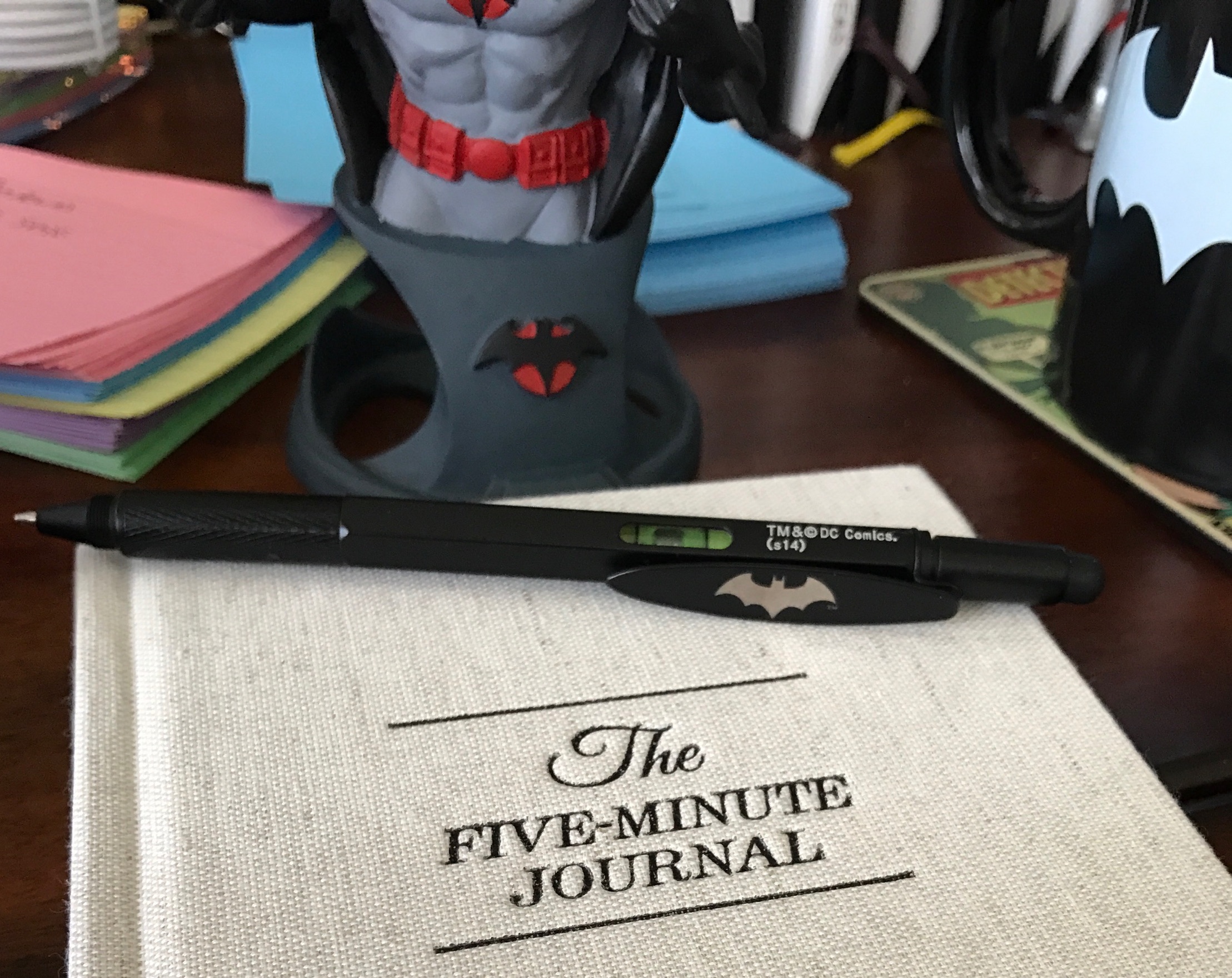
I’ve been using The Five-Minute Journal lately. It’s something that The Gorgeous One and I are doing together (although we don’t read each other’s journals). It uses a morning and an evening entry system. It sets up what I expect for the day and reminds me of what’s important. I also express a few words for self-motivation purposes. At night, I can evaluate how I did and what I need to change for the next day. I’ve used a Moleskine notebook in the past and wrote a bit more per entry but I like that this is targeted and concise and takes less time (thus the name, eh?).
6. Morning Reading
My morning reading is technical. This may be journal articles or chapters of a textbook. I’ve learned that I’m not a good technical reader at night although sometimes it’s necessary. Doing my technical reading when I’m fresh has helped with retention a great deal. I’ve moved my less technical reading to the evenings. This is less demanding and helps be wind down as well as getting away from the computer screen. Even though I have a blue light filter on the computer, I’ve been trying to get away from it more.
7. Neuro Coffee (get 15% off your first order with the coupon code IFASTPT)
I’ve been trying to decide if this is what truly gets me out of bed in the morning. It’s become the favorite part of my morning ritual. Never having been a coffee drinker, it confounds me a bit. I’m enjoying it way too much. Strangely, I’ve had situations where Neuro Coffee was unavailable (vacation/travel), and I’ve tried other coffee. Still tastes like dirt.
Neuro Coffee at this time supports my learning process. By drinking it after reading, I take advantage of the benefits of increased BDNF and the caffeine in regard to the impact on memory. Again, it’s purely subjective, but I’m finding it beneficial.
8. Morning Mini-Mobility
This is new in just the last couple of weeks or so. I have always noticed that I solve problems and make more creative connections during light mobility activities and long-duration aerobic exercise (and audiobooks). I’ve added this not only to promote some creativity before writing but to work on a couple of movement issues I’m working on. Each exposure buys me better movement and comfort in my 50-year-old self (I’ll sneak some in throughout the day as well). If I can get some creativity out of it, all the better. Don’t forget to breathe through such activities. Breathing is movement.
9. Writing
By now, the Cerevan is kicking in and creativity has been stimulated. Time to write. It may be a blog post, a larger project I’m working on, or just a brain dump to get some ideas out of my head and on paper in one of my notebooks or writing out a stack of notecards. I’ve been hitting no less than 1,000 words a day. I’m hopeful that something useful is coming out it. If anything, I’m feeling good about it and writing mostly for myself. That matters.
10. Off to IFAST to train.
At this point, it’s off to IFAST. Mondays and Fridays are intensive training days. Tuesdays and Saturdays are moderate to easy days. This is feeling really good and supporting my current goals. No need to change at this point.
Start your ritual on Monday.
“It is the parent who has born me: it is the teacher who makes me a man.” – Bushido
It seems the universe is speaking to me lately. Several things have indicated to me that It wants me to write something about the importance of mentors. My readings of late, and the recent visit from my good friend Dr. Bryan Chung (PT/OT, PhD, MD, plastic surgeon) have all led me to ruminations in regard to why mentorship is important, and how a Padawan should best take advantage of the Master-Padawan relationship.
History and entertainment are filled with representations of great thinkers and achievers who all began their development as Padawans.
Luke and Obi-wan (and then Yoda)
Alexander and Aristotle
Bruce Lee and Ip Man
Faraday and Davy
Daniel-san and Miyagi
Robin and Batman (what? Did you think I wouldn’t include this one?)
The best explanation I’ve read in regard to why the mentor-student relationship is so important comes from Robert Greene’s Mastery:
“The reason you require a mentor is simple: Life is short; you have only so much time and so much energy to expend. Your most creative years are generally in your late twenties and on into your forties. You can learn what you need through books, your own practice, and occasional advice from others, but the process is hit-and-miss. The information in books is not tailored to your circumstances and individuality; it tends to be somewhat abstract. When you are young and have less experience of the world, this abstract knowledge is hard to put into practice. You can learn from your experiences, but it can often take years to fully understand the meaning of what has happened. It is always possible to practice on your own, but you will not receive enough focused feedback. You can often gain a self-directed apprenticeship in many fields, but this could take ten years, maybe more.”
I’ve been fortunate to have had several mentors at key times in my life whether they were coaches, teachers, friends, or colleagues. I’ve also been in situations where I’ve been isolated and had to rely on my books and my brain mixed with some safe experimentation to find my way. I’d have to agree that mentorship is a catalyst to accelerate learning and effective practice.
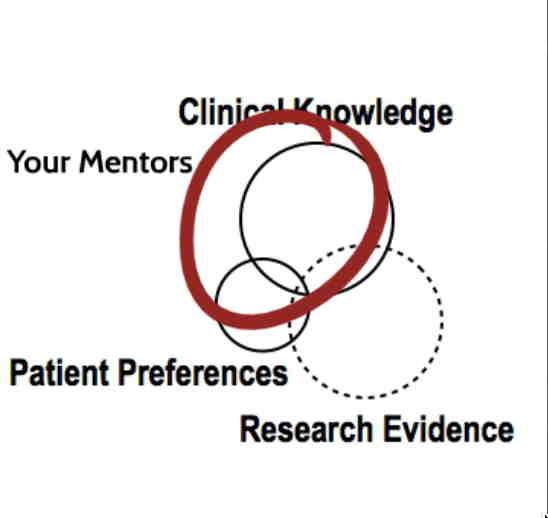
Bryan’s (AKA Dr. Chung’s) recent lecture at IFAST wrapped with some great advice that pointed toward the topic of the need and value for mentorship. Bryan presented a modified representation of Gordon Guyatt’s model of evidence-based medicine.

Of note is the modification of the influence of research evidence in the development process. It’s not that it lacks value, but when considering a Padawan’s knowledge base upon entering into the student-mentor relationship, he may not even be able to read the peer-reviewed research critically to draw effective, accurate conclusions or associate new information with his current level of understanding. The mentor, through clinical experience and accumulated knowledge of his own, provides a filter and a concentration of information that allows the Padawan to absorb a greater total quantity of useful information in a shorter period of time. Associations can be presented that a Padawan may never have made on his own.
Bryan’s model then is further modified to reflect the important influence of the mentor in regard to the Padawan’s model for learning.

With this in mind, here are some advices (Arnold fans… did you see what I did there?) to assist in getting the most out of a mentorship.
Be a Sellout
I don’t mean this in the negative sense. What I’m implying is that you need to accept your mentor’s way as THE way at least temporarily. It is the fastest and easiest way to take advantage of their wisdom and expedite understanding. Prior to your mentorship, request books, readings, or videos that will support your learning process from the mentor’s perspective. A word of caution is necessary. Not all instructors are great mentors. At times, you may struggle with that fact. Endure as long as no ill intent is demonstrated as part of an interaction toward you or others. I’ve personally had “mentors” that unintentionally taught me to recognize what I did not want to become. Given time, people tend to show you who they really are. It’s painful but can be just as valuable.
Personalize the Mentorship
Every Padawan I teach is required to make a list of all the questions, topics, methods, and techniques in their notebook that they want to cover during their internship. Each week time is spent on addressing items on the list to assure that the Padawan receives his or her optimal experience. If the Padawan is dissatisfied, it is then his or her fault for not completing the list. If This is done in addition to all other elements of the process that I deem essential to improve how the Padawan should think, behave, and problem solve.
If you are dissatisfied with your side of a self-chosen mentor-student relationship (some are forced into bad situations), take responsibility for it. You either chose the mentor unwisely or lacked the effort to take advantage of the relationship.
Observe and “Steal”
There are many things that are difficult to explain or express due to the specificity of situations that may occur in a client or patient interaction. Words, phrases, and body language all influence the outcome. Pay attention. Borrow stories, explanations, mannerisms, and jokes. In other words, steal a mentor’s “rap” until you develop one of your own.
Eddie Van Halen idolized Eric Clapton and is probably still capable of playing his music note for note, yet his playing sounds nothing like Clapton’s. Eddie did not invent tapping on the fretboard, but he evolved it into something unique and created his own style.
This reminds me of two things. One is the famous Bruce Lee quote, “Absorb what is useful, reject what is useless, add what is specifically your own.”
The second is a scene in the movie Finding Forrester where writer William Forrester instructs the young Jamal Wallace to start typing on of Forrester’s essays with the intent that the act of typing will lead Jamal to write his own words. In other words, borrow mine to find yours.
Remain critical and challenge your mentor’s ideas
You must eventually become independent in your thoughts and professional interaction. Your evolution to independence does not begin after your mentorship. It is an ongoing process from day one. While it is imperative that you accept the ways of your teacher as THE way at least initially, remain critical of everything that you’re presented. Go deeper and explore anything your find interesting or confusing or contradictory. Formulate questions that will allow you to access your mentor’s thoughts and reasoning that even he may not even be aware of. Challenge his ideas. Take his thoughts and compare them to your own. Experiment. Create something unique.
“Poor is the pupil who does not surpass his master.” – Leonardo da Vinci
Essential Reading: Mastery by Robert Greene


