Author: Bill

  • What book would you gift to someone trying to improve their life?

    What book would you gift to someone trying to improve their life?

    Changing your lifestyle is more about how our brain works, how we learn, and our behaviors than it is about the workout, the diet, or any of the specifics. That’s not to say that the specifics don’t have importance as they are the executables that ultimately represent the change.

    One of the keys to making learning and change stick is the concept of interference.

    As we learning new behaviors (or anything for that matter) it seems that the more we do something the faster we learn it. Repetition is a key element to behavior change and learning, but evidence shows that if we interrupt pure repetition of one concept with learning something else at the same time, we learn both concepts better.

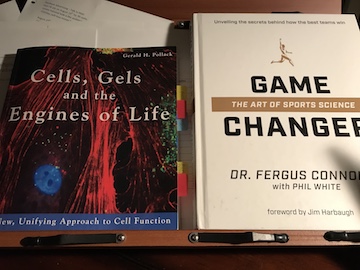
    As you work your way through ALL GAIN, NO PAIN, you can enhance learning the principles by reading something else too. I’m usually reading 2-3 books at the same time. (currently reading Cell, Gels, and the Engines of Life, Game Changer, and The Undoing Project)

    To help others out, what books have you found valuable in regard to supporting behavior change? Learning? Attitude? Pain? Exercise?

    Here’s a few off the top of my head:

    The Obstacle is the Way
    Explain Pain
    The Upside of Stress
    Why Zebras Don’t Get Ulcers (my favorite book)
    The Willpower Instinct
    Ego is the Enemy

    Oh, and don’t forget fun stuff too:

    The Dark Knight Returns 😎

    What book would you give to someone as a gift to impact their life, attitude, or for fun?

  • ALL GAIN, NO PAIN Knee Pain Solution for Lunges and Split Squats

    If you experience knee pain during lunges or split squats, it’s often not tight quads or hip flexors. Many times it that the quads are working overtime to stabilize the pelvis because your hip musculature is incapable of doing so.

    Foam rolling and stretching will typically fail or provide only a partial or temporary solution. Gaining control of the pelvis through better hip and pelvis position and muscle engagement often resolves the knee symptoms quickly. Give this knee pain exercise solution a try.

    Get the 7 Secrets to a Pain-Free Comeback to the Gym below!

  • How Answering One Simple Question Can Keep You on Track for Success

    How Answering One Simple Question Can Keep You on Track for Success

    This morning’s meditation was a good one.

    Not only did I feel confident in my efforts and level of concentration, but I was left with the powerful phrase “is this useful?”

    For meditation purposes, “is this useful” was intended to be used as means to determine the importance those thoughts that seem to invade our minds and pull us away from attending to the breath. I agree that it’s a simple mantra to return focus to the present task, but I also think it may be even more valuable.

    What if we apply “is this useful?” to every challenge as we make efforts to change our supportive behaviors for the better?

    Asking ourselves this question at the opportune times could make all the difference in reinforcing our desired behaviors or defaulting to our usually destructive behaviors.

    If your goal is to wake up earlier to begin a productive day, before hitting the snooze alarm to get that nine minutes of low-quality light sleep, ask yourself “is this useful?” Wouldn’t it be better to score the first win of the day by getting up and attacking your first task.

    When faced with the dilemma of choice when dining out with friends and selecting your meal between what you planned to eat and what looks or sounds more appetizing in the moment, ask yourself “is this useful?” Isn’t it better to enjoy the company of your friends AND stick to your eating plan to support your health and physical transformation.

    When determining whether you’ll follow through on today’s intended workout or skip it to watch a movie or surf the internet, ask yourself “is this useful?” Your workout will enhance your endurance and stress tolerance, build muscle, and establish a habit of physical activity to support brain and body health.

    If you’re feeling anger or resentment that never seems to benefit anyone, ask yourself “is it useful?” Once you get over it, does it change anything for better to have wasted valuable time (life?) on such negative emotions?

    Even better, as yourself this question using your own name with non-first person self-talk. Instead of the simple question “is this useful?” Try “Bill (use your own name of course), is this useful?”

    This method will engage higher centers of your brain that will inhibit default emotional centers that tend to knock us off course from our goals and true desires.

    Start practicing this today. Write on a notecard and put it in your pocket. Check it periodically

    When you feel challenged to react contrary to your intentions, just ask yourself, “is this useful?”


  • Client Wisdom:  On Consistency

    Client Wisdom: On Consistency

    Dave S. is one of my favorite humans. He’s a client at our gym IFAST in Indianapolis, but he began his story as a patient in my purple physical therapy room. He was dealing with back pain that began during workouts at another gym. Like many, he wasn’t broken, but pain severely curtailed his ability to enjoy life and his workouts. As he said, “He is training for life.”

    Oftentimes, limitations in our movement repertoire place stress, tension, or pressure on structures of the body that will result in a pain. In regard to Dave, his assessment went really well, but he did demonstrate an inability to access and utilize all of his hip mobility is several tests.

    “HIPS!!!   MY HIPS were the problem!!??  My limitations began with “back problems,” but were really my hips. Made me feel like an 80-year-old with osteoporosis.” – Dave S.

    We can never really say that one limitation is a cause of pain elsewhere, but if we look at ourselves as a whole, limited movement in one area of the body may result in compensations that place increased stress on other areas of the body. The assessment process merely provides a starting point to make good exercise decisions and a comparison for progress.

    With Dave, we initiated a simple process of individualized exercises to reduce undesired or restrictive muscle activity that was getting in his way. This included his daily resets and readiness exercises to focus on his movement limitations.

    “CONSISTENT commitment from day to day helps breed personal success from month to month.” – Dave S.

    Very quickly, Dave was back at it in the gym starting with modified exercises to keep his workout effort and satisfaction high. From there it was simple progression of following the Statute of Workout Limitations (see All Gain, No Pain Chapter 19) to even greater intensity.

    The ALL GAIN, NO PAIN Statute of Workout Limitations*

    • Limit weight to allow pain-free movement
    • Vary the exercise pattern to allow pain-free execution
    • Limit the speed of movement to pain-free rates of movement
    • Limit the joint motion of an exercise to pain-free ranges
    • Modify the rest periods between sets of exercises to alter intensiveness
    • Include Readiness and Supplemental Exercises to overcome our stress pattern

    “One of the new interns mentioned that my workout was one of the hardest he had seen anyone do… The seasons and the pounds have come and gone, but I must say that I have never had this kind of success in the gym in my entire life.” – Dave S.

    Where do you start with the ALL GAIN, NO PAIN

    The No Pain Principle #1:  Know thyself is your self-assessment to determine your own personal starting point. It’s the “point A” to lead you toward “point B.” Without knowing your challenges, your exercise program may be too generalized to address your specific needs. It’s also difficult to measure progress based on your key performance indicators (see ALL GAIN, NO PAIN Chapter 20) that are essential for motivation and targeting exercise selection to areas of need.

    *modified from: Verkhoshansky, Y., Siff, M Supertraining, 6th Ediition – Expanded Version.  (Distributed by Ultimate Athlete Concepts USA, 2009).