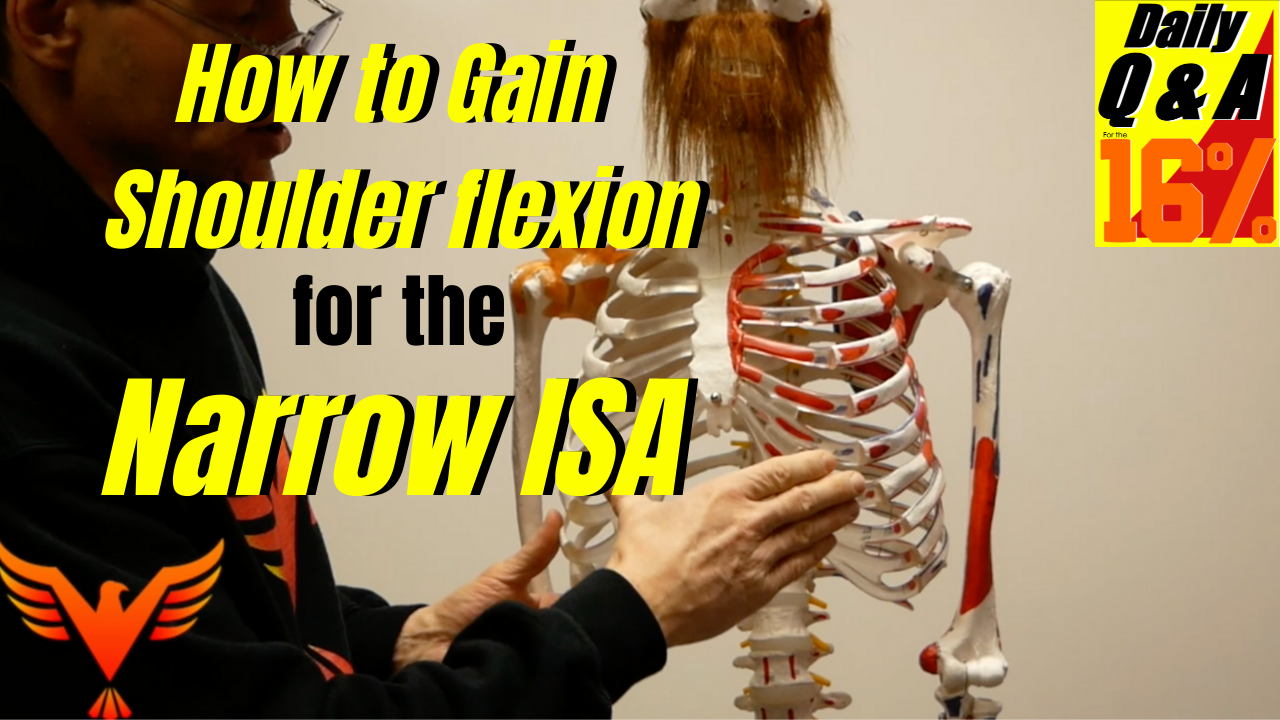
Clients with wide infrasternal angles and narrow infrasternal angles tend to benefit from different strategies in regard to improving shoulder flexion range of motion.
Shoulder impingement or simple achieving a normal overhead reach without using a compensatory reaching strategy is built from the lower thorax upward.
This video explains why it’s important to improve the lower posterior rib cage expansion for narrow ISA individuals, and how to do it.
The hamstrings are often blamed for the limitation in the ability to touch your toes.
There’s a lot more to it.
What’s required:
Normal breathing
Dorsal-rostral expansion
Infrasternal angle dynamics
Eccentric orientation of the erector spinae
Eccentric orientation of the posterior hip muscles
Upper cervical extensionIn this video, I’ll explain each of these needs and limitations as well as demonstrate a few gym exercises that will help you touch your toes.
The orientation of the pelvis and thorax influence the shape of the axial skeleton as well as the position of the glenoid and the acetabulum. This, in turn, influences muscle orientation and action to produce the available range of motion that is available during movement or table tests.
In this video, manipulate the Padawan’s position intentionally, to demonstrate how axial skeleton orientation directly influences range of motion measures.
Bill Hartman’s Weekly Q & A for the 16% – December 8, 2019: https://youtu.be/dvAufow_1Fg
The QB Docs Podcast with Drew Kiel and Bill Hartman: https://youtu.be/hNmwdAo-k-E
The IFAST Podcast #6 with Mike Robertson and Bill Hartman – Our Client Foundation: https://youtu.be/Y4kmtvla6ZM
Manual Therapy – Mobilization to Increase Shoulder Flexion and Cervical Rotation: https://youtu.be/WgfF-EfEPsM
This week on Instagram (@billhartmanpt):
Treatment sequencing
The Terry Project
Thorax shape and shoulder external rotation/shoulder internal rotation
The QB Doc Podcast Highlights
Videos for The 16%
This week’s questions:
When squatting, what do you believe the risk/reward is for oly shoes or some sort of heel lift. I know the obvious benefits/risks but in you’re opinion, which outweighs the other? Does it put that much more stress on your knees? Does it allow you to stack your pelvis better? Hip IR?
How would you approach working with a patient that was diagnosed with a condition related to central sensitization such as fibromyalgia or complex regional pain syndrome? Are there any specific compensatory strategies you have found to drive central sensitization (or what we may perceive to be central sensitization)?
For a wide ISA individual trying to regain his/her squat pattern, what progressions do you use after goblet/kettlebell/zercher squats? In light of Mike Robertson’s complete coach course I think the safety squat bar will be a good squat progression – allowing you to load the squat pattern and keep posterior thorax open for expansion. Do you use the safety squat bar much to load/progress the squat pattern?
How do you determine if a proxy measure of the extremity is pathological (ex. ligamentous laxity, capsular instability)? On the opposite end, how would you determine a true tissue extensibility limitation assuming you’ve maximized axial position and respiratory variability? How would you treat these two presentations differently?
Piggy-backing off last week’s question, what tests or measures do you apply to determine whether the elbow is oriented towards ER/pronation or IR/supination?
From a practical standpoint, what would be do with a narrow campo angle vs. a wide campo angle? I understand that it is a representation of the superficial helical angle that compresses the underlying axial helices, but how does it actually change our approach to gaining more variability or more performance?
Why might we use rolling activities for a wide infrasternal angle and quadruped activities for a narrow infrasternal angle ? Can you give an example of an activity for both scenarios?
So with respect to internal pressure of the guts and diaphragm with high rate of force production in say a high box jump. You’d want a diaphragm that can concentrically yield and concentrically overcome very quickly?
Please, please, please elaborate on how getting into a cut is “ER” and out of a cut is “IR”. In my myopic, acetabulum on femur way of looking at things, it seems as if “loading” should be acetabulum on femur IR and “exploding” should be the reverse. Thanks for all the content!
Understanding secondary consequences of programming
Is there such a thing as muscle weakness?
Simple cervical mechanics
For The 16% videos
This week’s Q & A questions:
• How does the orientation of the pelvis influence movement options available at the ankle? I am curious to your thoughts, specifically in the context of speed skating where top performs express a high degree of ankle flexion.
• When addressing elbow orientation via training, what is the deciding factor when choosing between an elbow flexion or extension driven activity? A specific case would be someone who has an ER’d humerus and pronated forearm You’ve touched on the fact that we don’t really know why people feel better after interventions. It makes sense to me that even if interventions are “specific” there are many things going on simultaneously. I was wondering if you could elaborate on this and possibly your own evolution regarding this. You recently shared a case on Dorsal-Rostral expansion helping improve a patient’s height and “corrected head forward posture” and although we aren’t necessarily after improving static positions posture, I’m wondering how expanding into the upper back would not result in more kyphosis / HFP?
• When you say the word “orientation” are you saying that relative to the spine? If so, why do you use the spine to establish orientation?
• When you say “inhaled” versus “exhaled” are you talking about ribs and spine or just spine? If both ribs and spine then why is a narrow ISA inhaled if their lower ribs are in an exhaled position?
• Have you ever seen cases where the pelvis appears to have changed “orientation,” but the ribs still appear to be wide or narrow? If so, can you explain the mechanism behind that and how you continued treatment from there?
• When treating someone, are there different criteria or things that you look for when deciding what to target first – ribs, pelvis, spine, etc?
• I have heard the concept of “tissue quality” being discussed with many typical musculoskeletal “diagnoses”. Do we as physical therapists and fitness professionals have a good definition of what good tissue quality is?
• What would you say are the biggest factors that impact somebody having an inhaled and exhaled skeleton (Wide Vs Narrow ISA)? How much does a person’s injury/training history come in to play? I can understand how strength athletes develop wide ISA’s but was wondering if there are any sports/events that can impact to position of the axial skeleton.
• I work with some volleyball players and I am trying to work on their squat using the box squat. Given that they do not get much lower than about a ¼ squat when they jump in their sport, what depth should I focus on getting them to? 90o? Just above 90o? Should the goal be to get 120o of hip flexion to give them full excursion of their respiratory cycle? Defensive/back row players sometimes end up in a deeper squat position when digging the ball, should it be lower for them?
• In the “How to Measure Infrasternal Angle” youtube video, I got the interpretation that a Wide ISA is indicated by an opening/increase in angle with inhalation without a legit closing with exhalation and that a Narrow ISA is indicated by a lack of opening with inhalation. Is this correct?
• Does the resting measurement of the ISA give us any useful information and if so what does it tell us and how does it guide intervention?
• Does the outcome of the ISA test (wide vs narrow) effect the prescribed exhalation or exhalation strategies (sigh vs pursed lip) used during prescribed interventions?
• What do you do when an ISA is dynamic one side or one side tests as Wide and the other narrow?
• If someone measures with a ISA of 60 degrees at rest and it widens but doesn’t completely close is this person considered a wide ISA? Would be considered to be an exhaled axial skeleton biased individual?