Author: Bill

  • Weekly Update and Q & A for October 27, 2019

    Weekly Update and Q & A for October 27, 2019

    Videos on youtube this week:

    Last week’s Q & A:  https://youtu.be/IEoZmlJ2UUI

    Bill’s Instagram

    • Evaluate in context
    • Dorsal-rostral expansion
    • How to measure hip flexion
    • Peterson step-ups and low back RFESS
    • Eccentric orientation activities IG story saved.

    This week’s Q & A Topics:

    • Bill can you give a quick overview about the propulsion phases?
    • Can you explain eccentric/concentric orientation? Is it different than short or long
    • How do you approach rehabbing a core muscle injury/sports hernia?
    • Advice on handling current DPT education knowing that much of it is no longer best practices.
    • Bill, are you seeing any differences in typical presentations from the neck up (e.g. c-spine, jaw, palate) in people with an inhalation bias vs exhalation bias?
    • Is there any case where you would try to cue a position or action from the neck up along with biasing IR/pronation/extension/dorsiflexion or ER/supination/flexion/plantar flexion?
    • If the squat is an expansion pattern and deadlift is a compressive pattern, does that mean someone with a narrow infrasternal angle would generally be better at a squat since they have more space to expand into, or would they generally be better at a deadlift since they are already in an exhaled/compressed position?
    • Can you expand a bit more on what is going on in the suitcase carry you posted on your recent video? I tried it myself with a test-retest of internal and external rotation of my shoulders and there was a significant improvement.
    • Why a squat is an eccentric/expansive/inhale biased movement pattern?
    • Why a hinge/press/pull are concentric/compressive/exhale biased movement patterns?
    • Apart from the squat what are the other (if any) key expansive movement patterns – single leg/single arm movements?
    • if someone has an anteriorly rotated pelvis that is in an exhaled position with limited hip mobility, what will be the first step/exercise that you would use?
    • What is the most impactful philosophical book you have read?

    Find Bill:
    Instagram

    Facebook

    Twitter

    LinkedIn

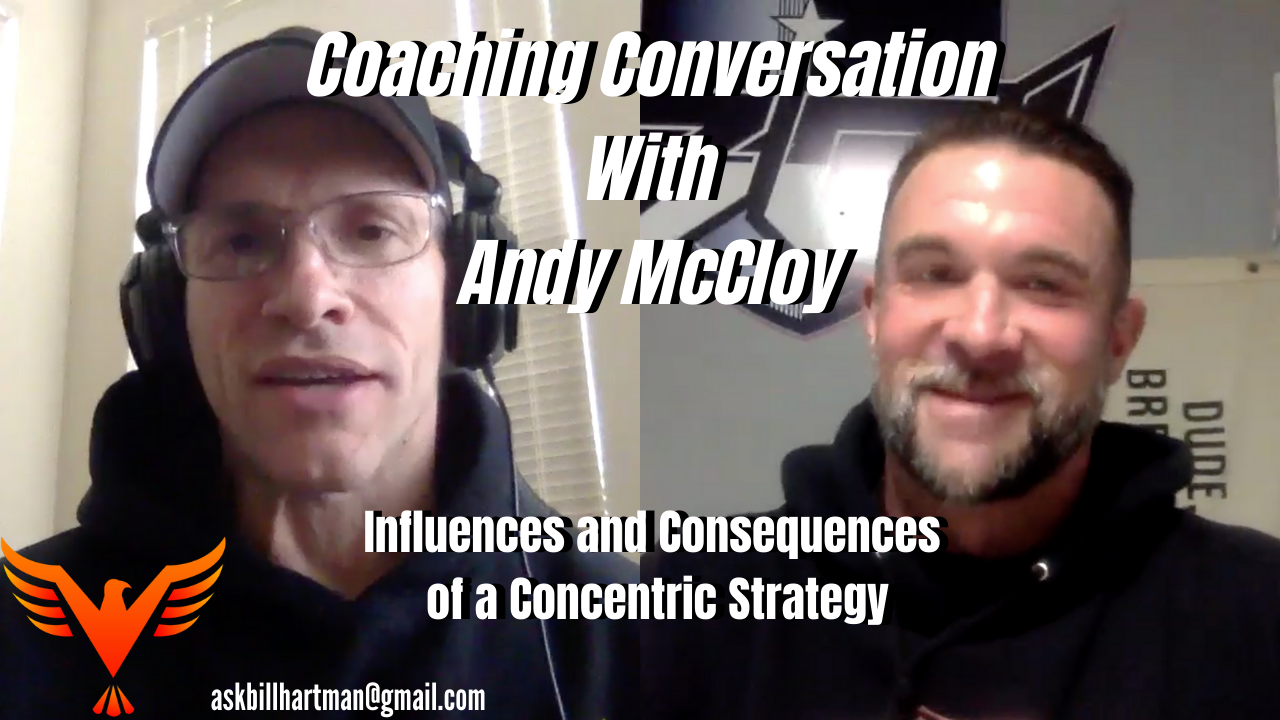
  • Coaching Conversation with Andy McCloy

    Coaching Conversation with Andy McCloy

    I had a chance to speak with a great human being, Andy McCloy, about some of his training challenges and issues associated with his new hips (we have this in common). We touched on a lot of topics in a 30-minute conversation. Watch the video or listen to the podcast.

    Topics of Conversation:

    • My benefits from drinking from The Fountain of Youth (what?!)
    • The secondary consequences of hard, intense training
    • Intrathoracic, intraabdominal, and intramuscular pressure
    • Muscle hypertrophy and gym strength
    • Genetic influences on adaptation and muscle hypertrophy
    • Self-assessment of movement and adaptability in the gym
    • The difference between a deadlift and the squat for compression and expansion
    • How heavy lifting creates a compressive, concentric strategy
    • The limitations of breathing exercises for big, strong humans
    • Are leg extensions okay for muscle hypertrophy?
    • A mature mindset for training
    • The importance of KPI’s (key performance indicators) for self-assessment


    Instagram

    Facebook

    Twitter

    LinkedIn


    Find Andy McCloy:

    http://andymccloy.com/about-andy-mccloy/

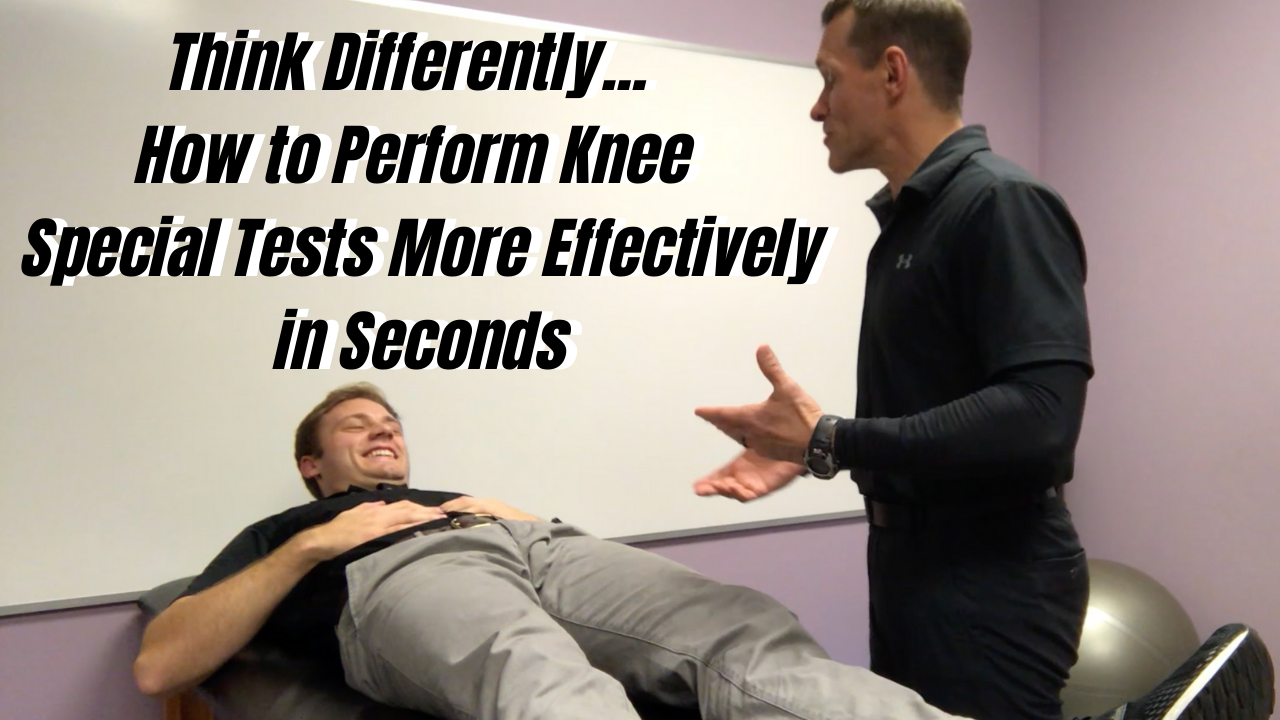
  • Think Differently… How to Perform Knee Special Tests More Effectively in Seconds

    Think Differently… How to Perform Knee Special Tests More Effectively in Seconds

    Knee special tests vary in their sensitivity, specificity, and usefulness. In the acute situation, they may provide some useful information to guide decision-making for further diagnostic testing if symptoms, behavior, or progress warrant such.

    With practice, the execution of some of the knee special tests can be simplified to a great degree to reduce the intrusiveness and time investment.

    While they can be done quickly, take the time to be effective. Also, use a battery of tests rather than relying on a singular test for decision-making.

    Demonstrated:
    McMurray Test for meniscus
    Varus and Valgus Stress for medial collateral and lateral collateral ligament
    Anterior Drawer for ACL injury (modify the angle for Lachman’s Test)
    Knee hyperextension

    askbillhartman@gmail.com

    Instagram

    Facebook

    Twitter

    LinkedIn

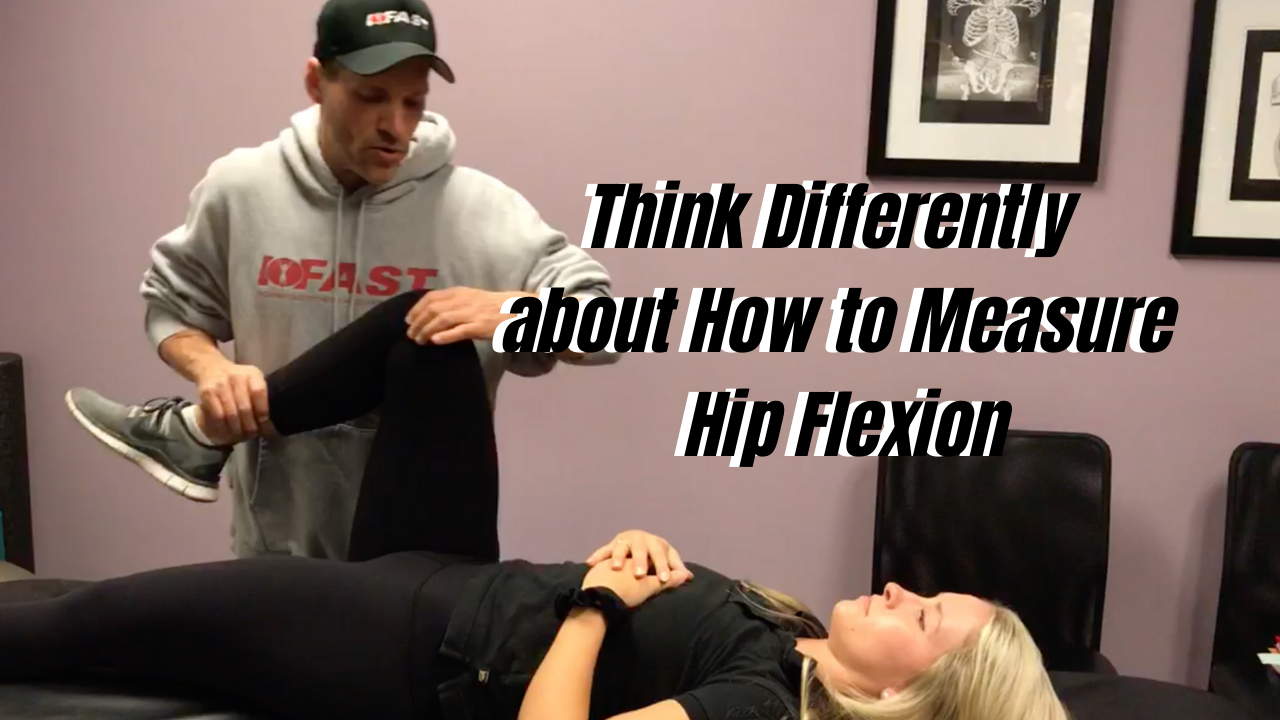
  • Think Differently… About How You Measure Hip Flexion

    Think Differently… About How You Measure Hip Flexion

    Traditionally, measuring hip flexion range of motion provides only information about how the femur moves in the hip joint.

    If you think differently, hip flexion provides information about the existence of anterior pelvic tilt, sacral movement, lumbar spine movement, and breathing strategy.

    This video guides you toward how you can think differently about how to measure hip flexion range of motion whether you work in physical therapy, athletic training, or fitness training.

    Have questions?

    askbillhartman@gmail.com

    Instagram

    Facebook

    Twitter

    LinkedIn

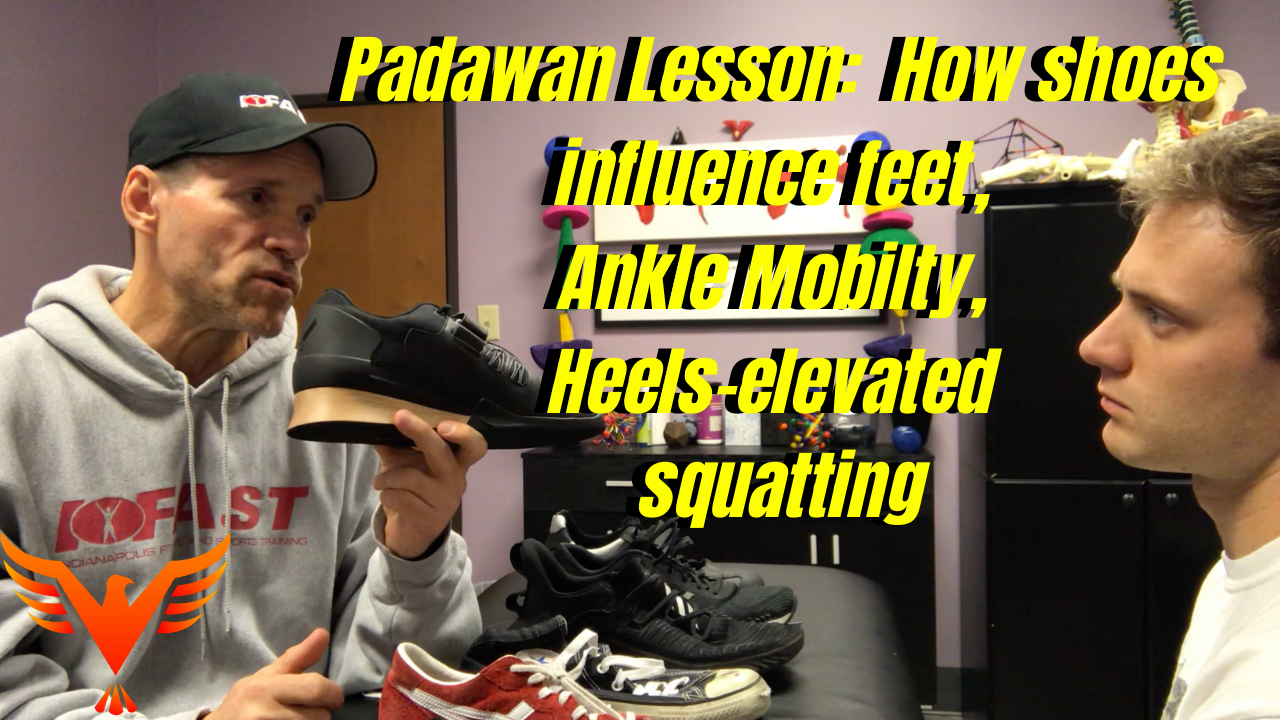
  • The Best Shoes for Improving Squat Depth and Squatting More Weight

    The Best Shoes for Improving Squat Depth and Squatting More Weight

    In this Padawan Lesson video, we address many common questions associated with choosing best shoes for squatting.

    • Do you really have an ankle mobility problem?
    • Do my shoes limit my mobility?
    • How can you increase squat depth?
    • What does an Olympic weightlifting shoe with an elevated heel do?
    • Are heels elevated squats bad?
    • Why do powerlifters use Chuck Taylor’s for lifting?
    • How do my shoes influence my propulsive strategy?
    • What shoes are better for agility?
    • Do my shoes change my feet?
    • What is the best heel to toe ratio for my shoes?
    • What places me at risk for an ankle sprain?
    • Does a concentric or eccentric global strategy allow me to move better?

    Find more:

    Instagram

    Facebook

    Twitter 

    LinkedIn