Tag: eccentric orientation

  • Bill Hartman’s Weekly Q & A for The 16% – December 8, 2019

    Bill Hartman’s Weekly Q & A for The 16% – December 8, 2019

    Links to this week on YouTube:

    This week’s topics on Instagram (@billhartmapt):

    • Thoracic outlet syndrome and breathing
    • When to prescribe the prone Y exercise
    • Get Client Buy-in Who can you help get better?
    • Simple self-test for breathing
    • Understanding secondary consequences of programming
    • Is there such a thing as muscle weakness?
    • Simple cervical mechanics
    • For The 16% videos

    This week’s Q & A questions:

    • How does the orientation of the pelvis influence movement options available at the ankle? I am curious to your thoughts, specifically in the context of speed skating where top performs express a high degree of ankle flexion.

    • When addressing elbow orientation via training, what is the deciding factor when choosing between an elbow flexion or extension driven activity? A specific case would be someone who has an ER’d humerus and pronated forearm You’ve touched on the fact that we don’t really know why people feel better after interventions. It makes sense to me that even if interventions are “specific” there are many things going on simultaneously. I was wondering if you could elaborate on this and possibly your own evolution regarding this. You recently shared a case on Dorsal-Rostral expansion helping improve a patient’s height and “corrected head forward posture” and although we aren’t necessarily after improving static positions posture, I’m wondering how expanding into the upper back would not result in more kyphosis / HFP?

    • When you say the word “orientation” are you saying that relative to the spine? If so, why do you use the spine to establish orientation?

    • When you say “inhaled” versus “exhaled” are you talking about ribs and spine or just spine? If both ribs and spine then why is a narrow ISA inhaled if their lower ribs are in an exhaled position?

    • Have you ever seen cases where the pelvis appears to have changed “orientation,” but the ribs still appear to be wide or narrow? If so, can you explain the mechanism behind that and how you continued treatment from there?

    • When treating someone, are there different criteria or things that you look for when deciding what to target first – ribs, pelvis, spine, etc?

    • I have heard the concept of “tissue quality” being discussed with many typical musculoskeletal “diagnoses”. Do we as physical therapists and fitness professionals have a good definition of what good tissue quality is?

    • What would you say are the biggest factors that impact somebody having an inhaled and exhaled skeleton (Wide Vs Narrow ISA)? How much does a person’s injury/training history come in to play? I can understand how strength athletes develop wide ISA’s but was wondering if there are any sports/events that can impact to position of the axial skeleton.

    • I work with some volleyball players and I am trying to work on their squat using the box squat. Given that they do not get much lower than about a ¼ squat when they jump in their sport, what depth should I focus on getting them to? 90o? Just above 90o? Should the goal be to get 120o of hip flexion to give them full excursion of their respiratory cycle? Defensive/back row players sometimes end up in a deeper squat position when digging the ball, should it be lower for them?

    • In the “How to Measure Infrasternal Angle” youtube video, I got the interpretation that a Wide ISA is indicated by an opening/increase in angle with inhalation without a legit closing with exhalation and that a Narrow ISA is indicated by a lack of opening with inhalation. Is this correct?

    • Does the resting measurement of the ISA give us any useful information and if so what does it tell us and how does it guide intervention?

    • Does the outcome of the ISA test (wide vs narrow) effect the prescribed exhalation or exhalation strategies (sigh vs pursed lip) used during prescribed interventions?

    • What do you do when an ISA is dynamic one side or one side tests as Wide and the other narrow?

    • If someone measures with a ISA of 60 degrees at rest and it widens but doesn’t completely close is this person considered a wide ISA? Would be considered to be an exhaled axial skeleton biased individual?

    #infrasternalangle #wideISA #boxsquat

    Listen on iTunes

    Find Bill:

    Instagram

    Facebook

    Twitter

    LinkedIn

  • Power Training from the Inside-out

    Power Training from the Inside-out

    Power training is often measured or expressed as a product of our extremity movement.

    The reality is that if we are unable to move or control the forces produced internally, then our power production in any movement is compromised.

    We can manipulate exercises to emphasize different aspects of internal force management, but we need to look at how muscles work in a different way.

    Here, I introduce the concepts of seeing muscle position in a moment in time as concentric or eccentric orientation, and whether the muscles are overcoming or yielding. Post your questions in the comments.

    #powertraining #overcoming #yielding

    Find Bill:

    Instagram

    Facebook

    Twitter

    LinkedIn

  • Padawan Lesson:  Propulsion Concepts Applied to Cutting and Baseball Pitching

    Padawan Lesson:  Propulsion Concepts Applied to Cutting and Baseball Pitching

    We’ve been reviewing pressure and volume shifts throughout the pelvis that influence the pelvic diaphragm shape, position, and movement.

    In this video, we move up to the thorax to address the thorax movement, shape change, and airflow mechanics that occur with cutting to the side and a baseball throw.

    Just as we talk about propulsion, concentric and eccentric muscle orientation, and overcoming or yielding contractions in the pelvis, these same concepts apply to the thorax.

    Near the end of the video, we provide a visual representation of the thorax shape to help you understand the result of the conversation.

    If you have questions, please go to my instagram account and post them on the weekly Q & A request or email me at askbillhartman@gmail.com.

    instagram

    Facebook

    Twitter

    Linkedin


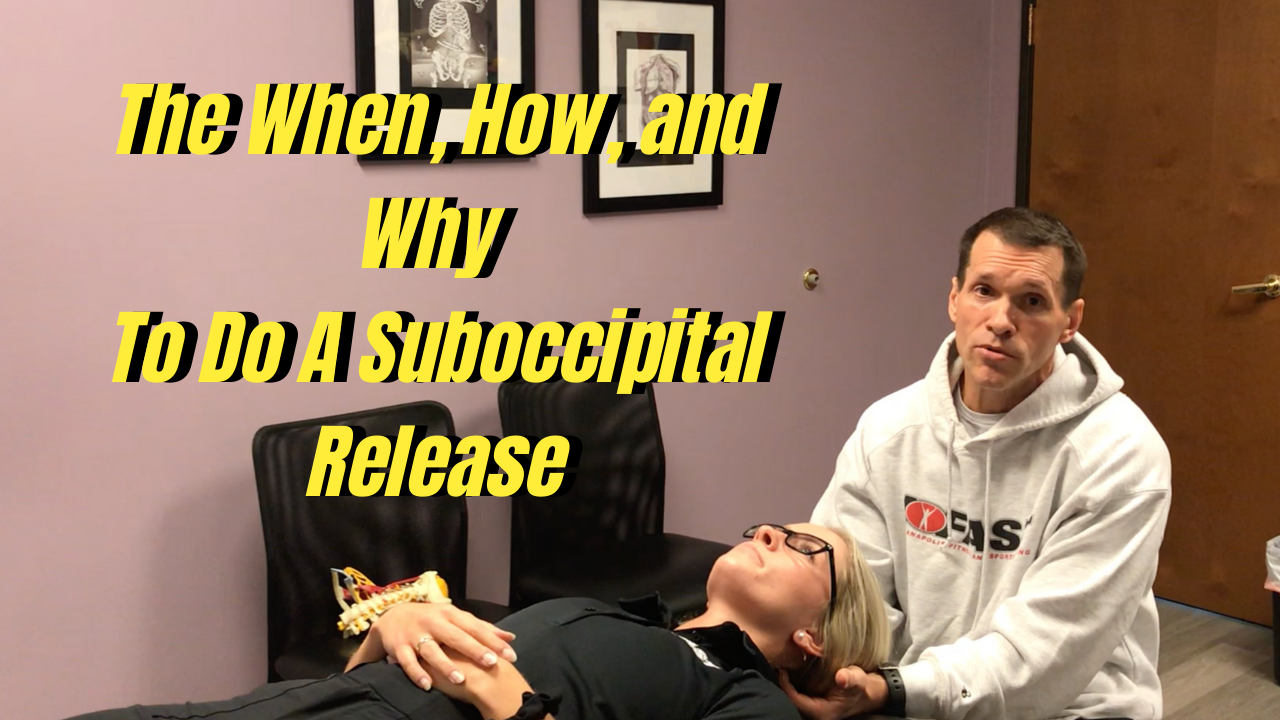
  • The How, When, and Why To Do a Suboccipital Release Manual Therapy Technique

    The How, When, and Why To Do a Suboccipital Release Manual Therapy Technique

    There may be multiple factors a play as to why any manual therapy may be useful. To simplify the model of application, right or wrong, we can just look at it as moving fluids in and out of a space or promoting concentric or eccentric orientation of muscles.

    A suboccipital release is a commonly applied tactic for various purposes and various diagnoses. How and when to apply it has always been rather vague, but over time, I’ve put together some reasoning and signs as to when it’s best to apply.

    A distracting technique can be applied if you find the following signs:

    • Limited ipsilateral hip flexion
    • Limited ipsilateral shoulder flexion
    • Greater ipsilateral mandibular lateral trusion
    • Greater ipsilateral upper cervical rotation

    When these signs are unilateral, use a compressive manual strategy on the contralateral side as shown in the video.

    For symmetrical presentations with the limitations mentioned above, apply the distraction manual technique bilaterally.

    If you find excessive upper cervical rotation, limited lower cervical flexion, and bilateral hypermobility of mandibular lateral trusions, then apply the compressive technique bilaterally.


    Instagram

    Facebook

    Twitter

    Linkedin

  • Weekly Update and Q & A for October 27, 2019

    Weekly Update and Q & A for October 27, 2019

    Videos on youtube this week:

    Last week’s Q & A:  https://youtu.be/IEoZmlJ2UUI

    Bill’s Instagram

    • Evaluate in context
    • Dorsal-rostral expansion
    • How to measure hip flexion
    • Peterson step-ups and low back RFESS
    • Eccentric orientation activities IG story saved.

    This week’s Q & A Topics:

    • Bill can you give a quick overview about the propulsion phases?
    • Can you explain eccentric/concentric orientation? Is it different than short or long
    • How do you approach rehabbing a core muscle injury/sports hernia?
    • Advice on handling current DPT education knowing that much of it is no longer best practices.
    • Bill, are you seeing any differences in typical presentations from the neck up (e.g. c-spine, jaw, palate) in people with an inhalation bias vs exhalation bias?
    • Is there any case where you would try to cue a position or action from the neck up along with biasing IR/pronation/extension/dorsiflexion or ER/supination/flexion/plantar flexion?
    • If the squat is an expansion pattern and deadlift is a compressive pattern, does that mean someone with a narrow infrasternal angle would generally be better at a squat since they have more space to expand into, or would they generally be better at a deadlift since they are already in an exhaled/compressed position?
    • Can you expand a bit more on what is going on in the suitcase carry you posted on your recent video? I tried it myself with a test-retest of internal and external rotation of my shoulders and there was a significant improvement.
    • Why a squat is an eccentric/expansive/inhale biased movement pattern?
    • Why a hinge/press/pull are concentric/compressive/exhale biased movement patterns?
    • Apart from the squat what are the other (if any) key expansive movement patterns – single leg/single arm movements?
    • if someone has an anteriorly rotated pelvis that is in an exhaled position with limited hip mobility, what will be the first step/exercise that you would use?
    • What is the most impactful philosophical book you have read?

    Find Bill:

    Instagram

    Facebook

    Twitter

    LinkedIn