Category: Professional Mentorship

  • Why Can’t You Touch Your Toes?

    Why Can’t You Touch Your Toes?

    The hamstrings are often blamed for the limitation in the ability to touch your toes.

    There’s a lot more to it.

    What’s required:

    • Normal breathing
    • Dorsal-rostral expansion
    • Infrasternal angle dynamics
    • Eccentric orientation of the erector spinae
    • Eccentric orientation of the posterior hip muscles
    • Upper cervical extensionIn this video, I’ll explain each of these needs and limitations as well as demonstrate a few gym exercises that will help you touch your toes.

    #toetouch #tighthamstrings #billhartmanpt

    Find Bill:

    Instagram

    Facebook

    Twitter

    LinkedIn

  • Arm Training for Athletes – 3 Mistakes

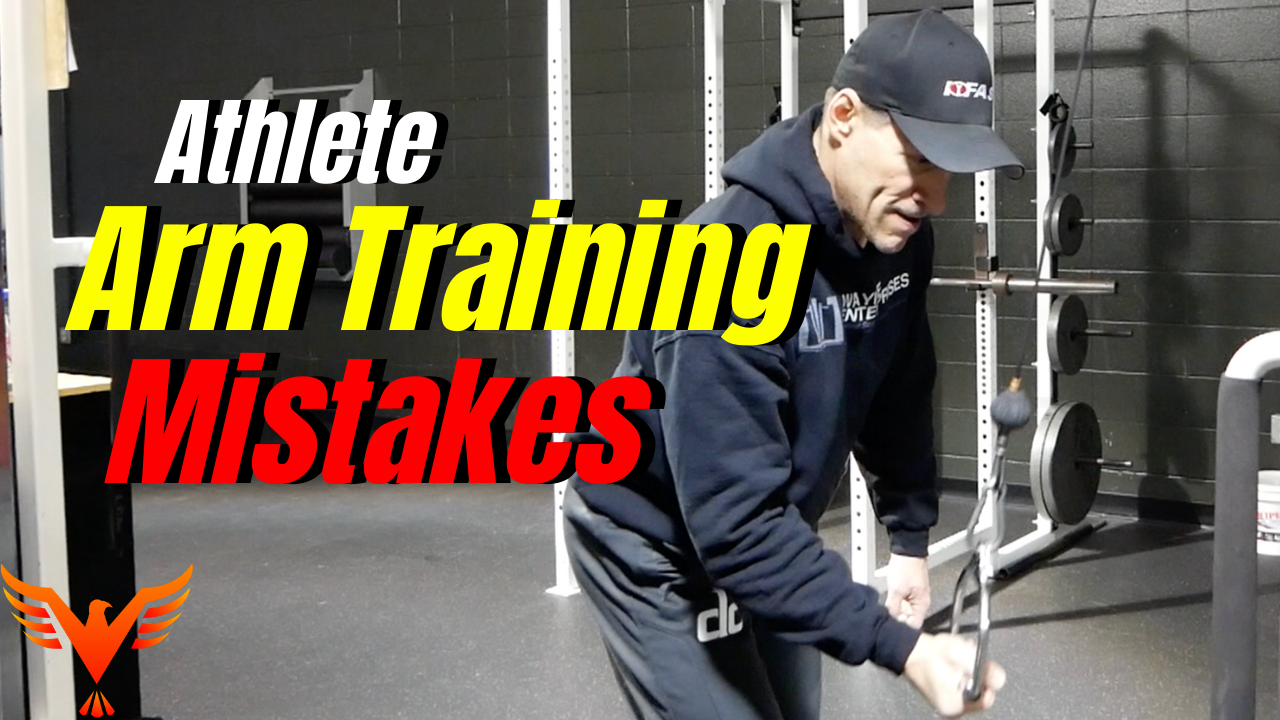
    Arm Training for Athletes – 3 Mistakes

    Here are 3 common mistakes when selecting arm training for athletes:

    1. Treating arm training as a throw-away exercise. Athletes like to look as good as they play, but their arm training cannot just be about big biceps and triceps. Arm training influences the neck, shoulder, rib cage, thoracic spine, and breathing. Pick the wrong arm training exercise for your athletes, and you may very well be the cause of a movement problem, shoulder pain, neck pain, or reduced performance on the field or the court.
    2. Not paying attention to the orientation of the body You may be training the right muscles, but if you put the body in the wrong position, you may be compromising shoulder and neck range of motion. On the flip side, if you position the body correctly, you may be able to restore full range of motion where it was limiting performance.
    3. Not appreciating the orientation of the upper arm, the forearm, and the wrist when selecting arm training for athletes. Golfer’s elbow (medial epicondylalgia, medial elbow pain, medial elbow tendonitis), Tennis elbow (lateral epicondylalgia, lateral elbow pain, lateral elbow tendonitis), and many other elbow pains can be associated with the relationship between the upper arm (humerus) and forearm. Your biceps exercise or triceps exercise may complicate or reduce an existing elbow problem. You wouldn’t compromise on your leg training. Why would you compromise arm training?

    #biggerbiceps #skullcrushers #billhartmanpt


    Find Bill:

    Instagram

    Facebook

    Twitter

    LinkedIn

  • Bill Hartman’s Weekly Q & A for The 16% – December 29, 2019

    Bill Hartman’s Weekly Q & A for The 16% – December 29, 2019

    Bill Hartman’s Weekly Q & A for The 16% – December 29,2019

    00:12
    This week on BillHartmanPT.com: What words are meaningful to your client: https://billhartmanpt.com/question-what-words-are-meaningful-to-your-clients/

    This week on YouTube: Bill Hartman’s Weekly Q & A for The 16% – December 22, 2019: https://youtu.be/IE0mjTb1z7g
    Why you should individualize exercise prescription: https://youtu.be/WOvkZ36Fmys

    This week on Instagram (@billhartmanpt):

    Finding your solution to your pain
    The importance and value of teaching to learn
    The evolution of your continuing education
    Videos for The 16%

    This week’s Questions:

    2:12
    Could you explain what’s going in the pelvic floor when someone is doing a goblet squat in the rack with a band attached to the J hooks so when they squat down it’s almost as if they are bouncing off of it! I’m curious about the intent behind it, when it’s appropriate, and why?

    4:28
    With your help to date my ‘hingey’ squat is looking more squatty (thanks!). To date, I have been using light front bar squats (circa 50kg including the bar). When the SSB arrives I am looking to increasingly load my squatty squat. My understanding is that targeting a squatty squat will help improve my movement variability by helping me become less exhale biased & compressed. But I also understand that improving force production may re-enforce my compressed exhale biased axial skeleton. In light of this – using the SSQ bar is there a limit to how much I should progress the loading of a squatty squat?

    7:35
    Does the ability to abduct the femur = pelvic diaphragm eccentrically orienting and the pelvic outlet closing. And the ability to adduct the femur = pelvic diaphragm concentrically orienting and pelvic outlet widening. Are these useful tests to figure out where someone is limited in the propulsion arc?

    9:41
    What typically is the underlying driver in an individual that presents with excessive femoral IR in standing static posture and excessive bilateral “leg whip“ when running? Is it typically an excessive anterior orientation of the entire pelvis vs a sacral nutation with Ilial ER?

    11:37
    What tests do you use to determine if you have a compressive strategy? -what is being compressed? -what is the result? 1

    3:26
    Do you believe the entire human body is a literal tensegrity structure? Or are there just some elements of tensegrity within the system. Read something interesting about how the spine can’t be a literal tensegrity structure because the compression elements do not actually cross each other.

    16:26
    I am very fascinated with pelvic mechanics at the moment and was hoping you could offer some good resources to learn from as well.

    #pelvicfloor #tensegrity #breathingexercises

    Find Bill:

    Instagram

    Facebook

    Twitter

    LinkedIn

  • Why you must individualize exercise prescription

    Why you must individualize exercise prescription

    You cannot blindly prescribe exercises based on the sport or the position that the athlete plays. Each athlete has their own personalized physics that determines how they perform.

    The exercise prescription should respect that fact.

    We must adapt the exercise, the cues, and the execution to meet the needs of the individual rather than just the perceived needs of the skill. Here I use baseball pitchers as an example of how generalized exercise programs for pitchers fail a large percentage of the athletes.

    #baseballpitcher #billhartmanpt #throwersten

    Find Bill:

    Instagram

    Facebook

    Twitter

    LinkedIn

  • Question:  What words are meaningful to your clients?

    Question: What words are meaningful to your clients?

    A question in regard to using common industry jargon in speaking with clients: What do your clients prefer to hear? Which words are relatable to them and their understanding?

    How we communicate certainly matters. We speak differently to different groups or individuals. Most of this happens unconsciously.

    We don’t talk to our closest friends and family the way we may speak with a new client at their first appointment.

    That first meeting with a client is important as it can set the tone for all future interactions as you work to establish rapport. Your questions should help you to understand “their story” which informs you of their desires, beliefs, and their level of understanding.

    They read what you and other professionals in the industry write on the internet, and in many cases, may use jargon-laden language because of their exposure. They want to present themselves in the best light and will attempt to speak your language or to use jargon in an attempt to do so even when they don’t really understand.

    In this case, it may be necessary for you to use similar language at first. This is referred to as “meeting them at their story.” It keeps the interaction comfortable and non-threatening. It provides a reassuring element to the new client that what they know or what they believe is okay for now even if they may be misguided.

    Consider a client who offers that they’ve been following The Ice Cream Diet.

    What not to do…

    You: Are you on any special diet program?
    Client: Yes, I follow the Ice Cream Diet.
    You: What?! That’s ridiculous! No one can lose weight eating ice cream.

    A better choice…

    You: Are you on any special diet program?
    Client: Yes, I follow the Ice Cream Diet.
    You: You’re eating regularly. That’s great. We can use that to your advantage to make the changes you’re seeking.

    You now have an element of their story. It is now your job to guide them away from what you’ve determined to be interfering with their process, and you can influence an existing behavior favorably to support their intention. This includes the language they use.

    As we guide the client through an exercise program, it is not necessary to pepper our instructions with unnecessary industry jargon or concepts. There’s a difference between meeting a client at their story and how an insecure coach defaults to jargon in an attempt to prove his intellect and worth to the client. Clients don’t really care what you know. They just want a coach to help them achieve the outcome they desire.

    The mythical neutral spine comes to mind in this instance.

    Other than the fact that it doesn’t exist and couldn’t be identified visually if it did, attempting to create a singular ideal promotes opportunities for failure and additional, distracting cognitive load on the client. Much like those that chase “good posture” as if there is just one elusive posture that we hope to attain someday. [author’s note: Sorry. Your mom was wrong. There’s no such thing as good posture.]

    While we’re on the topic, there is no one good knee position, one good foot position, one good hip position, one good neck position, or one good shoulder position. Rarely is there a best way. There should be many ways depending on the context. The ability to adapt tends to represent health in all systems.

    The human body has evolved to distribute loads and stresses throughout the movement system quite well. Movement is actually quite “noisy” in that there are constant adjustments, micromovements, and micromovements that must occur to assure this distribution of load as we move.

    Allowing a client to explore movement is a better choice. It allows them to evolve a sense of acceptable ranges of movement rather than chasing the imagined ideal that may actually create positions or restrictions that lead to discomfort, focal loads, and pain. Such an outcome is the failure of the coach to understand how the system moves. It is not the fault of the client or their body.

    Don’t misunderstand this to be an “anything goes” proposition in regard to exercise execution. Your purpose as the coach is to guide the process within those acceptable limits rather than restrict it. Teaching the exercise or activity within its context is sufficient to arrive at a successful outcome. Eventually, the exercise becomes the exercise for the client.

    A squat becomes a squat.
    A row becomes a row.
    A press becomes a press.
    A lunge becomes a lunge.

    No neutral spine cues are necessary.