From the Movie Bull Durham…
Crash Davis: You think I could make it to the show as a manager?
Annie: You’d be great, just great. ‘Cause you understand non-linear thinking even though it seems like baseball is a linear game ’cause of the lines and the box scores an’all — but the fact is that there’s a spacious-“non-time kind of time” to it…
Annie had sought spiritual enlightenment by immersing herself in numerous religions and substituted serial monogamy with younger men for mature relationships in hopes of finding some form of linearity. The end result was a realization that in her quest for simplification, she gained the understanding that while a simple domain is attractive for obvious reasons, humans are complex regardless of the attempts to simplify. She also learned that misjudgment of the complex as simple leads to confusion, chaos, and failure.
The straight lines of linearity are attractive because they are simple and predictable. Error is minimized.
Writing a perfect training program for an athlete or client at one time seemed simple as well. Do THIS and the result will be THAT. No adjustments required. Linear and predictable.
You may still think you have the capability to create such perfection, after all, you took that course or read that book that taught you how to write training programs.
Well, good luck with that.
But if that were true, all of your clients would be painfree, perfectly mobile, lean, jacked, world-class, and satisfied never seeking more advice outside of your control (yes, they do that, don’t they. Damn you internet!).
In the best of circumstances, you may be able to pull that off temporarily. Complex systems (humans) are nonlinear in nature. Complexity, while unpredictable and uncontrollable, promotes adaptability and survivability (Think health). Your model of client interaction (rehab, training, coaching, etc.) must reflect this complex domain (see Cynefin).
Some general thoughts in no particular order of importance:
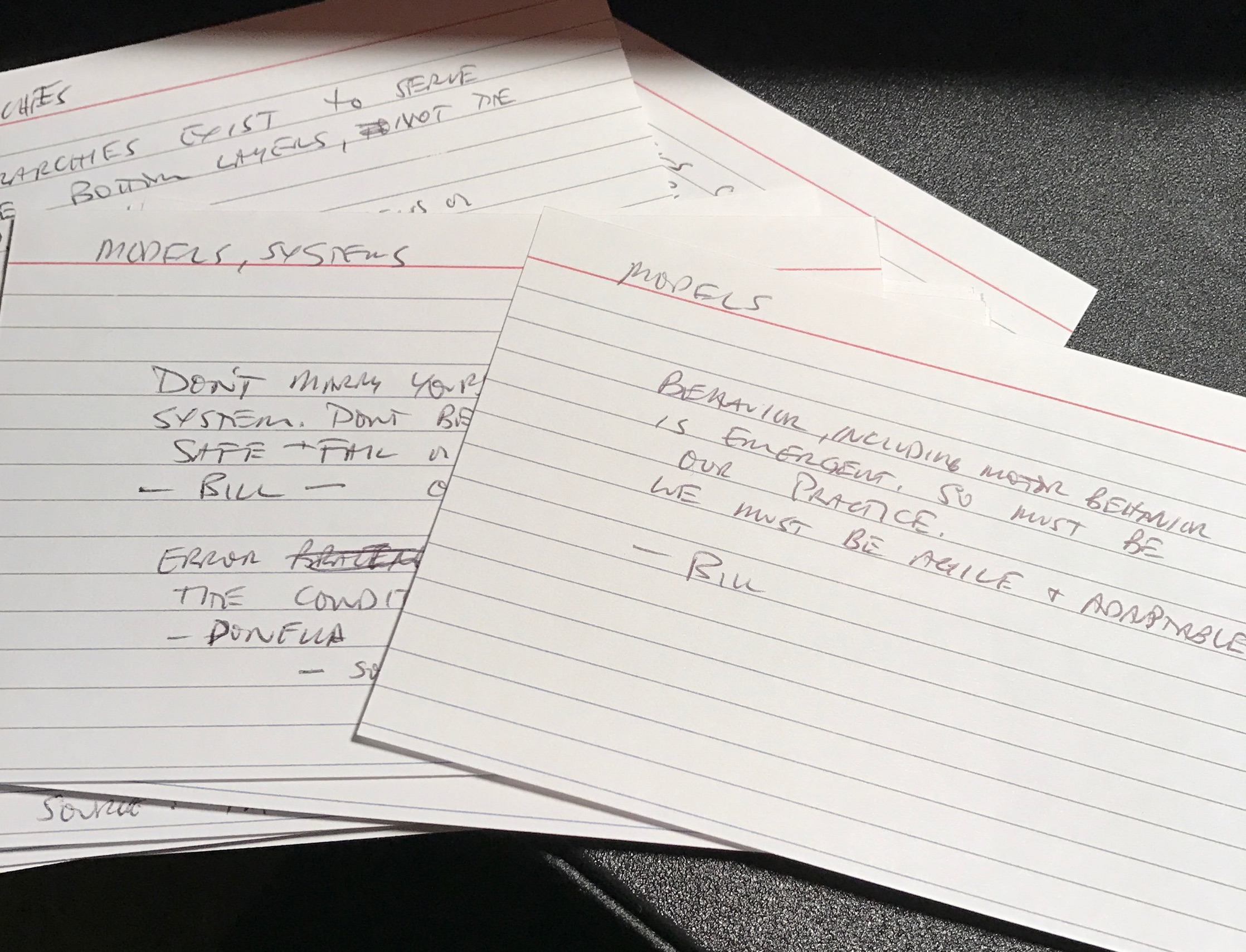
[Key element] Human behavior (posture, movement, expression, autonomic, etc.) is emergent based on self-organization, nonlinearity, and feedback. Our practice must be agile and adaptable to allow best practice to emerge (see Cynefin).
The overall goal should be to enhance all aspects of the human. Enhance health, growth, resilience, and longevity. All properties developed in moderation promote adaptability/variability. Performance training will narrow variability intentionally to demonstrate specificity, however, maintenance of all elements to some degree will mitigate potential illness and injury (you won’t prevent it. It’s too complex for our understanding right now).
Don’t marry yourself (react emotionally) to single system. Keep expanding your model to prevent stagnation in learning and application. Personally challenge all of your assumptions and hypotheses by comparing them to the evidence and the outcome. Share your hypotheses with other coaches and therapists. Discuss and don’t argue. Complex, nonlinear systems may have more than one correct answer to a problem.
“All models are wrong. Some are useful.” – George Box
Be willing to discard elements of your model that don’t hold up to scrutiny.
Write or draw out your model in detail to clarify your process. This will also enhance the agility of your modeling and thinking.
Don’t be afraid to make safe-failures or safe-mistakes (the kind that don’t hurt people).
“Error embracing is the condition for learning.” – Donella H. Meadows
Value what the client brings to interaction. Do not destroy the human’s ability to adapt. Complex systems (humans) can change dramatically for the good or for the bad. Interventions must be applied in small measureable doses (even when hard to measure). Monitor frequently and change the program as the client leads you. You may find that this happens within a single session or over a period of weeks.
At best, regardless of your self-perceived understanding, interacting in the complex domain successfully is done so through observation and coherence. We observe how the system (human) behaves or responds and then make logical decisions. Pay attention.
An inherent property of complex systems (humans) is the evolution of hierarchies as they promote resilience. Interventions within your model should target a top-down sequence as the higher sub-systems support and enhance the lower subsystems (Why do you think breathing is so important on so many levels?). Rushing to a reductionist conclusion to lower-levels in the hierarchy may occasionally result in apparent success. Don’t believe your own press and keep your ego in check. In most instances, you got lucky. Lack of respect for the hierarchical nature of the system will more often than not result in mistreatment and failure.
If you need me, I’ll be in Cancun sipping margaritas (Rocks… no salt!) by the pool.
Resources:
Bull Durham http://www.imdb.com/title/tt0094812/
www.cognitive-edge.com for more on Cynefin
Thinking in Systems by Donella H. Meadows. Chelsea Green Publishing. White River Junction, VT. 2008