Author: Bill

  • For the 16%… Is there value in ANY certification?

    For the 16%… Is there value in ANY certification?

    I am uncertified. I have been for quite a few years now. I’ll most likely stay this way.

    Anyone can create a certification. You can. I can.

    That immediately puts a limit on the value of certification.

    I am not anti-certification if there is a benefit to the association with a group.

    Careers evolve and there are times where joining a tribe provides an advantage for progress.

    But understand the negative consequences of association.

    The barrier to entry in the fitness industry is still very low. It is a young industry with growing pains. Perception of the value of an imaginary credential results in early, strong biases that ultimately stagnate learning and understanding when you should be gaining a breadth of knowledge.

    Looking through a singular lens creates blind spots in your ability to solve problems.

    While you may see the association with a group as advantageous, it will also create biases against you that may cost you.

    You get to make the call as to whether it’s worth it or not. Just don’t associate certification with qualification or education.

    Happy Birthday, USA.


    Click here to fill out your application to The Intensive VII

  • Announcement: The Intensive VII

    Announcement: The Intensive VII

    Are you ready for round VII?

    It’s the 1 year anniversary of The Intensive.

    Each one is unique as the curriculum is driven by the attendees.

    Only 8 professionals will be selected from the application process. Without question, keeping it small maximizes the benefits to the attendees

    Several attendees have applied multiple times. Not everyone is ready right away. Sometimes you need to struggle, learn, and grow before you get to attend. It’s not about your resumé. It’s about being a thinker.

    The When and Where

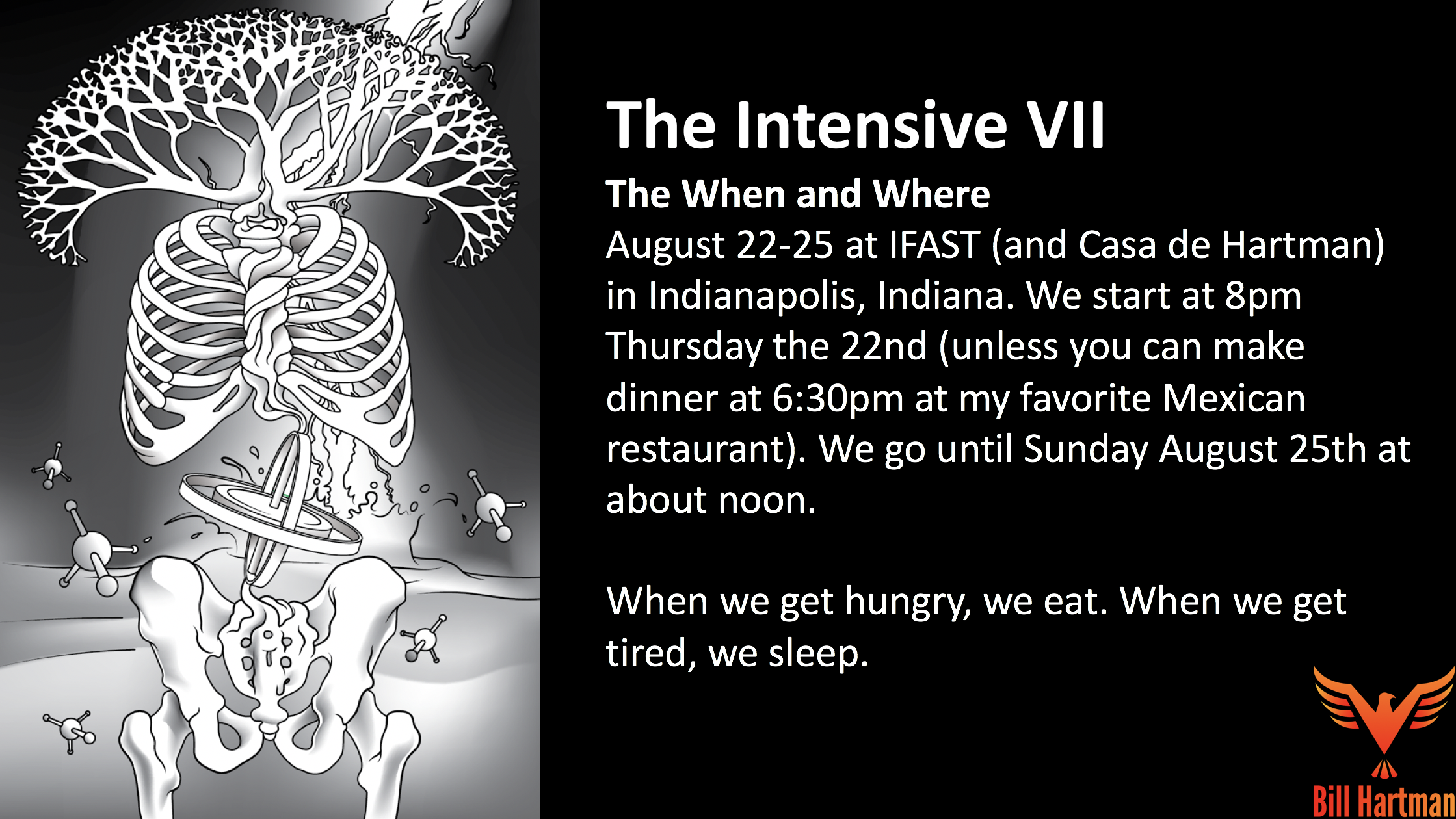
    August 22-25 at IFAST (and Casa de Hartman) in Indianapolis, Indiana. We start at 8 pm on Thursday the 22nd (unless you can make dinner at 6:30 at my favorite Mexican restaurant). We go until Sunday, August 25th at about noon. When we get hungry, we eat. When we get tired, we sleep.

    The Who

    Up to eight (8) professionals (It is NOT for students) who:

    Are comfortable with contributing ideas, asking, and answering questions.

    Have an understanding of foundational movement-based anatomy and exercise/training concepts.

    Want to challenge and help other professionals improve.

    Understand the value of a coach and seek a learning network of individuals with common concerns, interests, and goals but different backgrounds.

    Selfishly, it’s for me. I enjoy what I do, and I enjoy sharing ideas and interacting with bright, motivated people from whom I too can learn.

    The What

    A fun, open, engaging, and challenging environment

    Guided, focused effort over three days

    Develop a principles-based approach

    Examining a model of human movement from micro to macro

    Assessment processes from a passive to a dynamic environment

    Cuing, coaching, decision-making, intervention strategies, and programming

    Ongoing discussion and conversation over dinner at Casa de Hartman

    Enhance and evolve your personal information capture and learning system

    Share knowledge as part of an ongoing professional network

    Follow-up mentorship to assure ongoing progress

    Train at IFAST

    The eight individuals will be selected via the application process as quickly as possible. Attendees will be notified by July 17th.

    How Much?

    It is $699 to attend in addition to your travel expenses. Your food is taken care of.
    Apply for The Intensive VII Now.

  • The Model:  Desired Outcome > Constraints > Target

    The Model: Desired Outcome > Constraints > Target

    The desired outcome represents a broad perspective of the ultimate performance ideal without the consideration of context, perceived, or real limits and limitations. This may be categorized as a want or a need from the perspective of the patient, athlete, therapist, or coach.

    Examples:

    Walk without knee pain
    Reduce 100m sprint time
    Jump to touch 11 feet
    Create more defined looking musculature
    Increase deadlift 1 RM

    The constraints then begin to provide contextual elements, limitations, and absolute limits that overlap and influence the desired outcome.

    The constraints are imposed upon the desired outcome from the interaction of the physical constraints of the human, required task demands, and the performance environment (see Newell’s model). This interaction determines the degree to which the human constraints must be altered to move toward the desired outcome.

    Anatomy and physiology represent the behavioral and structural constraints of the human system that interact with perception. [Note: Behavioral constraints is my term. The literature uses the term functional constraints in this case. In my perspective, complex adaptive humans behave rather than function like complicated machines. Right or wrong, agree or disagree, this is my perspective, and I’m sticking to it.] According to Glazier interpreting Sparrow and Newell, constraints are internal or external boundaries, limitations, or design features that restrict the number of possible configurations of the many degrees of freedom that a complex system can adopt.

    Structural constraints are the relatively stable or slow changing elements within the system such as anatomy and anatomical relationships, genetics, neurology, muscle mass, body composition, joint movement potential, and the like. To simplify, it is the “stuff” when we refer to the human being 99% water and 1% stuff.

    Behavioral constraints, on the other hand, are those elements of the system that are capable of greater variability and change more rapidly. These constraints tend to be more related to physiological measure and psychological influences. Cardiovascular measures, thoughts, emotions, endocrinological changes, and sensation are considered in these behavioral constraints.

    Whereas the desired outcome represented the broader perspective of performance requiring potentially multiple layers of change within the system, the target represents the specific change intended by the immediate course of action within the working model. This may be a change in the behavioral or structural constraints depending on the current state of the system.

    Glazier, P. S. Towards a Grand Unified Theory of sports performance. Human Movement Science (2015), http://dx.doi.org/10.1016/j.humov.2015.08.001

    Sparrow and Newell 1998. Psychonomic Bulletin & Review 1998.5(2). 173-196

  • Padawan Lesson:  The Applied Philosophy of James Dalton and Why All PT Students Need to Watch Road House

    Padawan Lesson: The Applied Philosophy of James Dalton and Why All PT Students Need to Watch Road House

    A Padawan Lesson…

    Physical therapy, fitness training, or physical preparation for sport exist in the complex domain. This is the domain of many unknowns.

    Traumatic events affect individuals differently, and the interpretation is in the eye of the beholder. What may paralyze one person to a life of withdrawal, anxiety, or depression may motivate another to do great work for others. One’s history helps evolve their response to any interaction. You as a stranger to your new client may be perceived as a threat or friend. You just never know.

    Offense is the responsibility of the offended. This is by no means permission to intentionally insult or express some ignorant judgment on someone else’s physiology, decisions, or worldview. Your words must, therefore, be chosen wisely. You may hope to establish rapport with a new client by interjecting some humor with absolute kindness that ultimately backfires due to a lack of understanding or misinterpretation. Your client is now defensive and is incapable of the essential trust that assures a successful interaction. You just never know.

    A patient or client that would sue you for some perceived wrongdoing has already decided to sue you before even meeting you. They are merely waiting for an opportunity. On the flip side of the coin, there are those that would never consider suing you under any circumstances. Which of the two are now before you? You just never know.

    So how to do we avoid the possible negative consequences of any patient/therapist or coach/client relationship?

    The answer lies in the Philosophy of James Dalton.

    Dalton lived by three simple rules:

    Rule #1: Never underestimate your opponent; expect the unexpected.
    Rule #2: Take it outside; never start anything inside the bar unless it’s absolutely necessary.
    Rule #3: Be nice.

    Of Dalton’s three rules, it is the third rule that carries the most weight in a patient or client interaction. The patient’s perception of the success of that interaction is dependent on whether your patient thinks you are nice.

    Much like the application of universal precautions in regard to infection control and exposure to human bodily fluids, Dalton’s Third Rule is the universal precautions of personal and professional interaction.

    So be nice.

    You cannot predict your patient or client’s personal history nor their response to it.

    So be nice.

    A truly successful treatment outcome depends on establishing trust with your client or patient.

    So be nice.


  • Announcement:  The Intensive VI

    Announcement: The Intensive VI

    We just wrapped The Intensive V. Are you ready for round VI?

    The first five Intensives were outstanding experiences. Each was unique as the curriculum is driven by the attendees.

    As always, we are keeping this small to maximize the interactivity. Only 8 professionals will be selected from the application process.

    If you applied to The Intensive I-V before and would like to attend, please fill out a new application.

    The When and Where

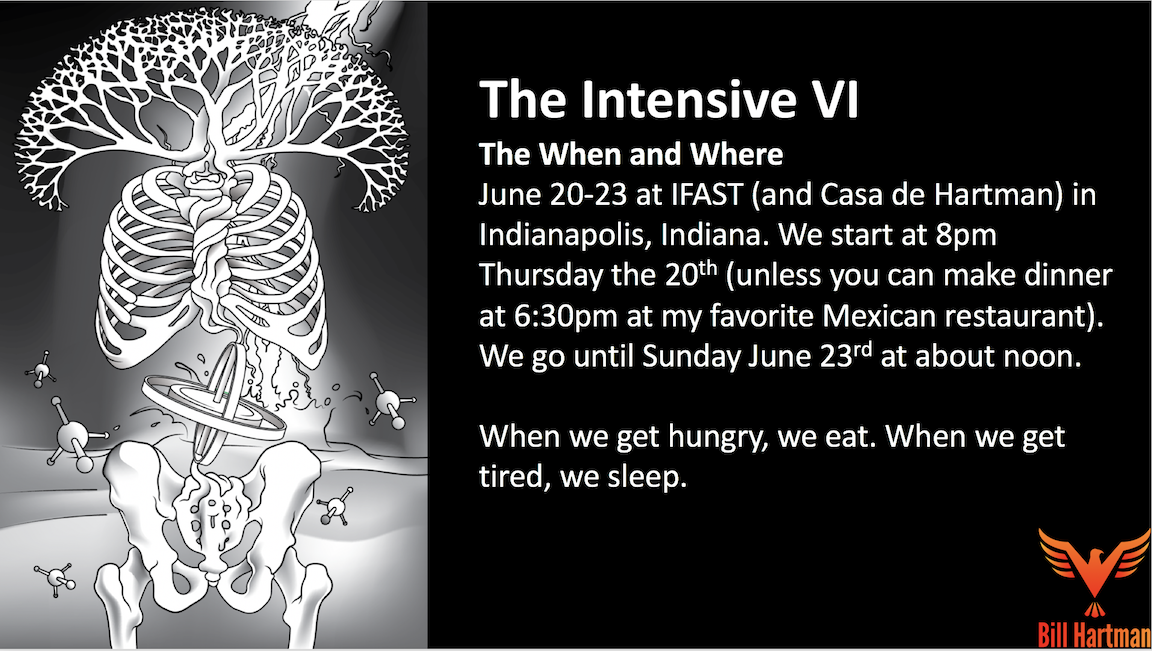
    June 20-23 at IFAST (and Casa de Hartman) in Indianapolis, Indiana. We start at 8 pm on Thursday the 20th (unless you can make dinner at 6:30 at my favorite Mexican restaurant). We go until Sunday, June 23rd at about noon. When we get hungry, we eat. When we get tired, we sleep.

    The Who

    Up to eight (8) professionals (It is NOT for students) who:

    Are comfortable with contributing ideas, asking, and answering questions.

    Have an understanding of foundational movement-based anatomy and exercise/training concepts.

    Want to challenge and help other professionals improve.

    Understand the value of a coach and seek a learning network of individuals with common concerns, interests, and goals but different backgrounds.

    Selfishly, it’s for me. I enjoy what I do, and I enjoy sharing ideas and interacting with bright, motivated people from whom I too can learn.

    The What

    A fun, open, engaging, and challenging environment

    Guided, focused effort over three days

    Develop a principles-based approach

    Examining a model of human movement from micro to macro

    Assessment processes from a passive to a dynamic environment

    Cuing, coaching, decision-making, intervention strategies, and programming

    Ongoing discussion and conversation over dinner at Casa de Hartman

    Enhance and evolve your personal information capture and learning system

    Share knowledge as part of an ongoing professional network

    Follow-up mentorship to assure ongoing progress

    Train at IFAST

    The eight individuals will be selected via the application process as quickly as possible. Attendees will be notified by May 13th.

    How Much?

    It is $699 to attend in addition to your travel expenses. Your food is taken care of.

    Application for The Intensive VI is now closed.