There were so many great elements to this discussion.
We need to stop looking at clients and athletes as dysfunctional.
Perhaps they don’t perform as desired, but the human movement system is providing the best solution at that moment within that context. It is our job to intervene effectively to get the system to respond as desired.
Welcome to complexity.
Here’s the link to the full podcast: http://theqbdocs.libsyn.com/tqbd-143-bill-hartman
The hamstrings are often blamed for the limitation in the ability to touch your toes.
There’s a lot more to it.
What’s required:
Normal breathing
Dorsal-rostral expansion
Infrasternal angle dynamics
Eccentric orientation of the erector spinae
Eccentric orientation of the posterior hip muscles
Upper cervical extensionIn this video, I’ll explain each of these needs and limitations as well as demonstrate a few gym exercises that will help you touch your toes.
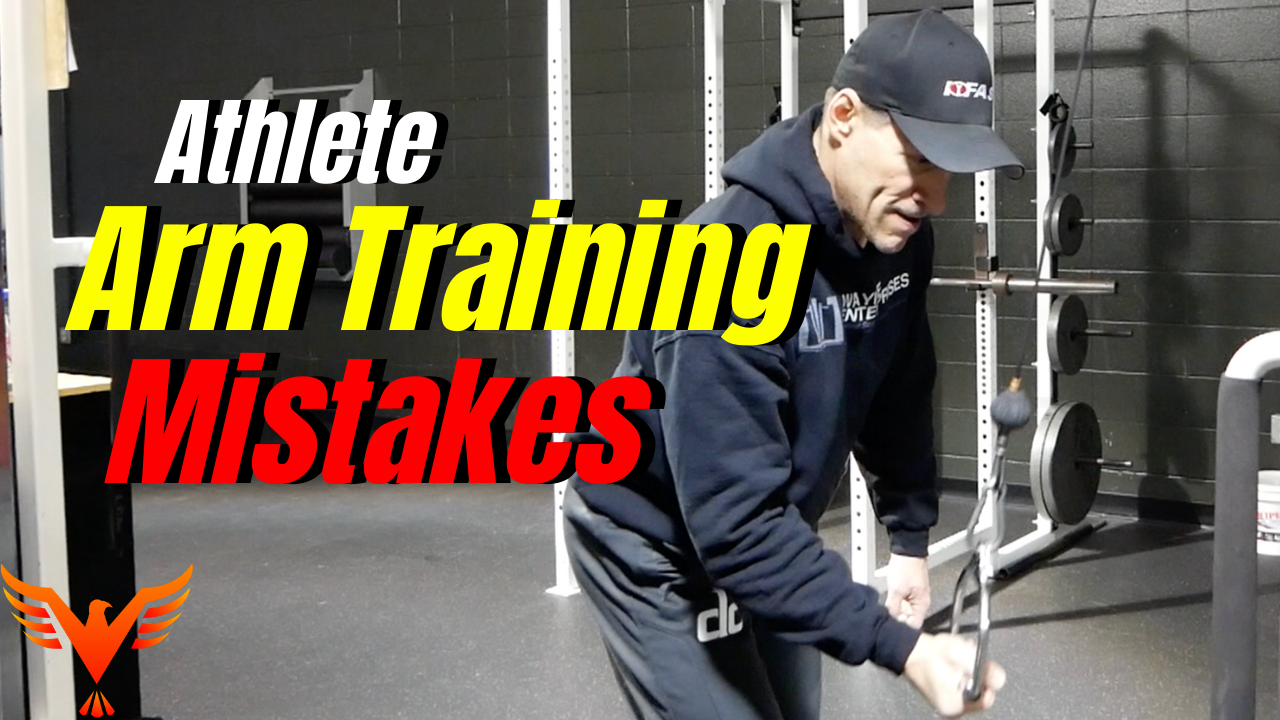
Here are 3 common mistakes when selecting arm training for athletes:
Treating arm training as a throw-away exercise. Athletes like to look as good as they play, but their arm training cannot just be about big biceps and triceps. Arm training influences the neck, shoulder, rib cage, thoracic spine, and breathing. Pick the wrong arm training exercise for your athletes, and you may very well be the cause of a movement problem, shoulder pain, neck pain, or reduced performance on the field or the court.
Not paying attention to the orientation of the body You may be training the right muscles, but if you put the body in the wrong position, you may be compromising shoulder and neck range of motion. On the flip side, if you position the body correctly, you may be able to restore full range of motion where it was limiting performance.
Not appreciating the orientation of the upper arm, the forearm, and the wrist when selecting arm training for athletes. Golfer’s elbow (medial epicondylalgia, medial elbow pain, medial elbow tendonitis), Tennis elbow (lateral epicondylalgia, lateral elbow pain, lateral elbow tendonitis), and many other elbow pains can be associated with the relationship between the upper arm (humerus) and forearm. Your biceps exercise or triceps exercise may complicate or reduce an existing elbow problem. You wouldn’t compromise on your leg training. Why would you compromise arm training?
Bill Hartman’s Weekly Q & A for The 16% – December 29,2019
00:12
This week on BillHartmanPT.com: What words are meaningful to your client: https://billhartmanpt.com/question-what-words-are-meaningful-to-your-clients/
This week on YouTube: Bill Hartman’s Weekly Q & A for The 16% – December 22, 2019: https://youtu.be/IE0mjTb1z7g
Why you should individualize exercise prescription: https://youtu.be/WOvkZ36Fmys
This week on Instagram (@billhartmanpt):
Finding your solution to your pain
The importance and value of teaching to learn
The evolution of your continuing education
Videos for The 16%
This week’s Questions:
2:12
Could you explain what’s going in the pelvic floor when someone is doing a goblet squat in the rack with a band attached to the J hooks so when they squat down it’s almost as if they are bouncing off of it! I’m curious about the intent behind it, when it’s appropriate, and why?
4:28
With your help to date my ‘hingey’ squat is looking more squatty (thanks!). To date, I have been using light front bar squats (circa 50kg including the bar). When the SSB arrives I am looking to increasingly load my squatty squat. My understanding is that targeting a squatty squat will help improve my movement variability by helping me become less exhale biased & compressed. But I also understand that improving force production may re-enforce my compressed exhale biased axial skeleton. In light of this – using the SSQ bar is there a limit to how much I should progress the loading of a squatty squat?
7:35
Does the ability to abduct the femur = pelvic diaphragm eccentrically orienting and the pelvic outlet closing. And the ability to adduct the femur = pelvic diaphragm concentrically orienting and pelvic outlet widening. Are these useful tests to figure out where someone is limited in the propulsion arc?
9:41
What typically is the underlying driver in an individual that presents with excessive femoral IR in standing static posture and excessive bilateral “leg whip“ when running? Is it typically an excessive anterior orientation of the entire pelvis vs a sacral nutation with Ilial ER?
11:37
What tests do you use to determine if you have a compressive strategy? -what is being compressed? -what is the result? 1
3:26
Do you believe the entire human body is a literal tensegrity structure? Or are there just some elements of tensegrity within the system. Read something interesting about how the spine can’t be a literal tensegrity structure because the compression elements do not actually cross each other.
16:26
I am very fascinated with pelvic mechanics at the moment and was hoping you could offer some good resources to learn from as well.
You cannot blindly prescribe exercises based on the sport or the position that the athlete plays. Each athlete has their own personalized physics that determines how they perform.
The exercise prescription should respect that fact.
We must adapt the exercise, the cues, and the execution to meet the needs of the individual rather than just the perceived needs of the skill. Here I use baseball pitchers as an example of how generalized exercise programs for pitchers fail a large percentage of the athletes.