I have my @neurocoffe, do you have yours for today’s
Q & A
From Eli:
I’m having a bit of shoulder issue. When I press overhead either with a dumbbell, barbell, or kettlebell, I get a pinching in my shoulder. When I reach overhead, I don’t seem to get it at all. Is there something that I can do for this? If you’re feeling this same kind of thing yourself, I’ve included a “gym fix” in the discussion.
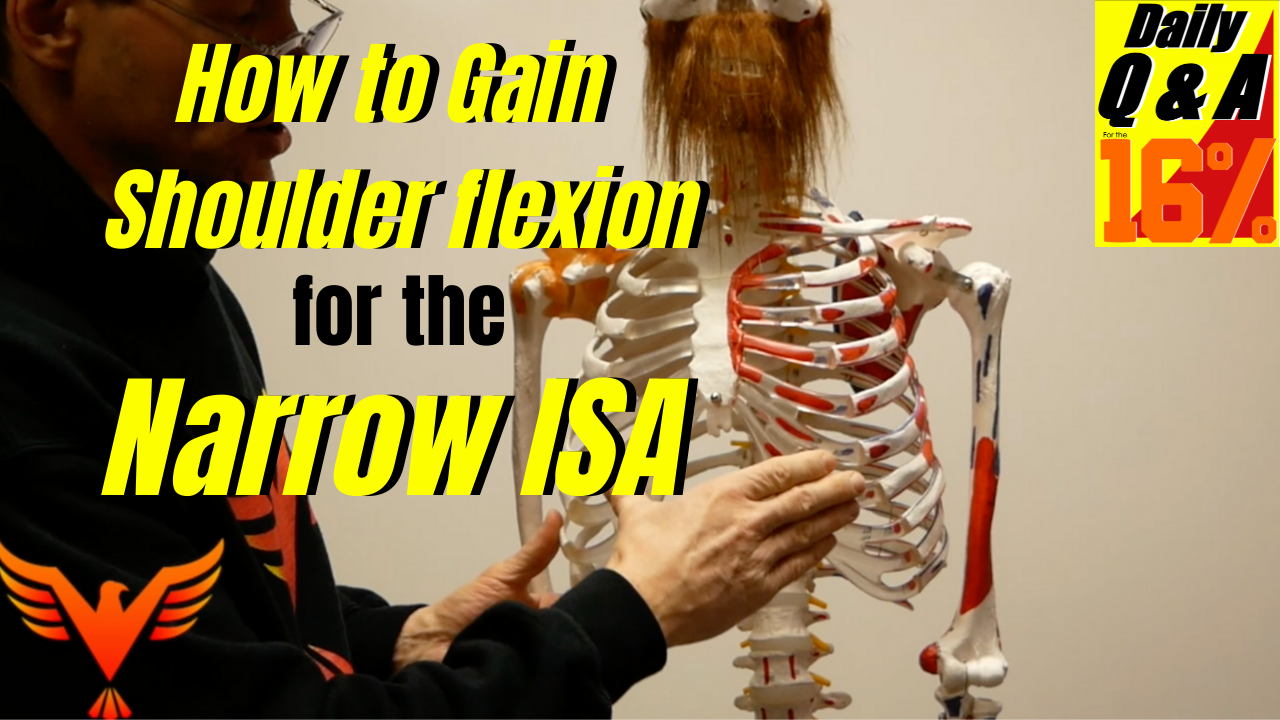
Clients with wide infrasternal angles and narrow infrasternal angles tend to benefit from different strategies in regard to improving shoulder flexion range of motion.
Shoulder impingement or simple achieving a normal overhead reach without using a compensatory reaching strategy is built from the lower thorax upward.
This video explains why it’s important to improve the lower posterior rib cage expansion for narrow ISA individuals, and how to do it.
In this discussion, we use the common I,T,Y exercises as a representation of how and when to individualize exercise prescription, and why you cannot generalize.
:10 Blind exercise prescription
1:00 I,T,Y may be the wrong thing to do
1:45 Concentric vs. Eccentric and “weakness”
2:40 A false external rotation measurement
3:04 Dorsal-rostral compression
3:28 You can’t generalize exercise prescription to baseball pitchers
4:20 The difference in baseball pitchers’ structure and influence on performance
5:45 When should elements of prescription be similar
6:00 Optimize exercise cues
7:00 Wide ISA compensatory strategy and dorsal-rostral compression
7:58 Who will benefit from the compression created by I,T,Y exercises
10:15 Is a compensatory strategy useful?
10:45 When the compensatory strategy limits health
12:00 Adaptations for performance vs. health
12:43 You can’t generalize prescription
13:20 Scapular winging
14:00 You can’t blame the scapula
14:30 Prescribing I,T,Y when you’re already compressed
14:50 Misdiagnosing the need for strength
15:33 How can one muscle be weak?
16:20 Tissues benefit from load
16:41 How strong is strong enough?
17:00 The multifactorial nature of performance
17:16 When does dorsal-rostral compression benefit range of motion
18:28 The person diagnosed with GIRD
19:00 False positive external rotation
19:15 Prescribing I,T,Y exercise at the wrong time
19:29 External rotation and internal rotation occur at the same time
20:00 What do I,T,Y exercises or face pulls do at the scapulae
20:10 Is scapular retraction good?
20:25 The thorax moves forward during scapular retraction
20:30 Face pull demonstration
20:40 The failure of postural correction with I,T,Y exercises
21:29 Medial scapular border compression
21:54 Loss of external rotation with medial scapular border compression