Category: Homepage

  • Q & A for The 16% – Hip External rotation solution – Rib stiffness strategy – Hand to Shoulder ER/IR

    Q & A for The 16% – Hip External rotation solution – Rib stiffness strategy – Hand to Shoulder ER/IR

    I hope you made your @neurocoffee because I have 3 great Q & A’s for today.

    From Eduard:
    How do you distinguish between the genetically determined structure of being an narrow vs. wide and a body that starts for example as a wide and does tons of compressive hardcore weight and in result ends up as a narrow with excessive external obliques and now has to deal with that. 2 or even 3 layers of compensation on compensation overhelming this body. Would you still start with moving ISA first and then get the counternutation of the sakrum and the upper T spine going?

    From Brian:
    If someone exhibits a narrow ISA with an excessive lumbar lordosis and limited hip ER,  would a good strategy to improve the hip ER measures  be to work on activities to improve lower posterior thorax expansion to reduce the lordosis which is driving the anterior pelvis orientation ?

    From Matt:
    I saw your recent tricep push down video and noticed you say to push through the pinky side of your hands. I was wondering why this is, and how pressing through different parts of your hand can have different influences on the rest of the body. Is it at all similar to pressing through different aspects of your foot?

    #hipmobility #diaphragmaticbreathing #billhartmanpt

    Find Bill:
    Instagram

    Facebook

    Twitter

    LinkedIn

  • Q & A for The 16% – How the Thorax Influences the Shoulder – How Your Neck Influences Breathing

    Q & A for The 16% – How the Thorax Influences the Shoulder – How Your Neck Influences Breathing

    https://infastonline.com/

    Grab some @neurocoffee and sit back for today’s Q & A.

    From Zhang:
    Could you clarify the terminology describing the different regions of the posterior ribcage? Is the posterior ribcage divided into 3 areas, please correct me if I was wrong, as below:  – Posterior lower thorax – Dorsal rostral area – Upper dorsal rostral area What shoulder test would you use to identify the location of compression at the posterior ribcage?

    From Marcos:
    One question I’ve been wrestling with: what role does the neck muscles play in exhalation? Specifically, does depression of the adam’s apple or recruitment of the muscles at the back of the tongue promote better exhalation mechanics? My guess is that they promote a better head position, which affects breathing, but I wanted to get your thoughts.

    #diaphragmaticbreathing #shoulder #billhartmanpt


    Find Bill:

    Instagram

    Facebook

    Twitter

    LinkedIn

  • The Bill Hartman Podcast for The 16% – Season 2; Number 3

    The Bill Hartman Podcast for The 16% – Season 2; Number 3

    In this Podcast for The 16%…

    1. Wide Infrasternal Angle Treatment Strategies

    2. Relative Motion Vs. Orientation of the Pelvis

    3. Half-Kneeling from the Inside-Out

    4. Foot and Knee Mechanics – Pronation, Knee Valgus and Performance


    Find Bill:

    Instagram

    Facebook

    Twitter

    LinkedIn

  • Q & A for The 16% – Foot mechanics that influence the pelvis – Knee Valgus problems?

    Q & A for The 16% – Foot mechanics that influence the pelvis – Knee Valgus problems?

    Hope you have your @neurocoffee for today’s Q & A.

    From Austin:
    I had a question about a video you posted a couple months ago. In the “Improving hip internal rotation- toe touch” video (https://www.youtube.com/watch?v=9OTEdut5W_E), you mention using dorsiflexion to achieve sacral nutation and maintain mid to max propulsion. You also mention plantarflexion putting the individual in an early propulsive phase. Can you talk me through how dorsiflexion or plantar flexion influences sacral position?

    From Matt:
    I know you have work on knee valgus in athletes and to what degree is it not something to worry about because it potentially helps produce power.  I was wondering where I could find that info to read more about it?

    #kneevalgus #pronation #billhartmanpt

    Find Bill:

    Instagram

    Facebook

    Twitter

    LinkedIn

  • How Great Decisions Lead to the Undesired Outcome… and Vice Versa

    How Great Decisions Lead to the Undesired Outcome… and Vice Versa

    We can perceive today as a stressful time and may feel challenged to be making good decisions.

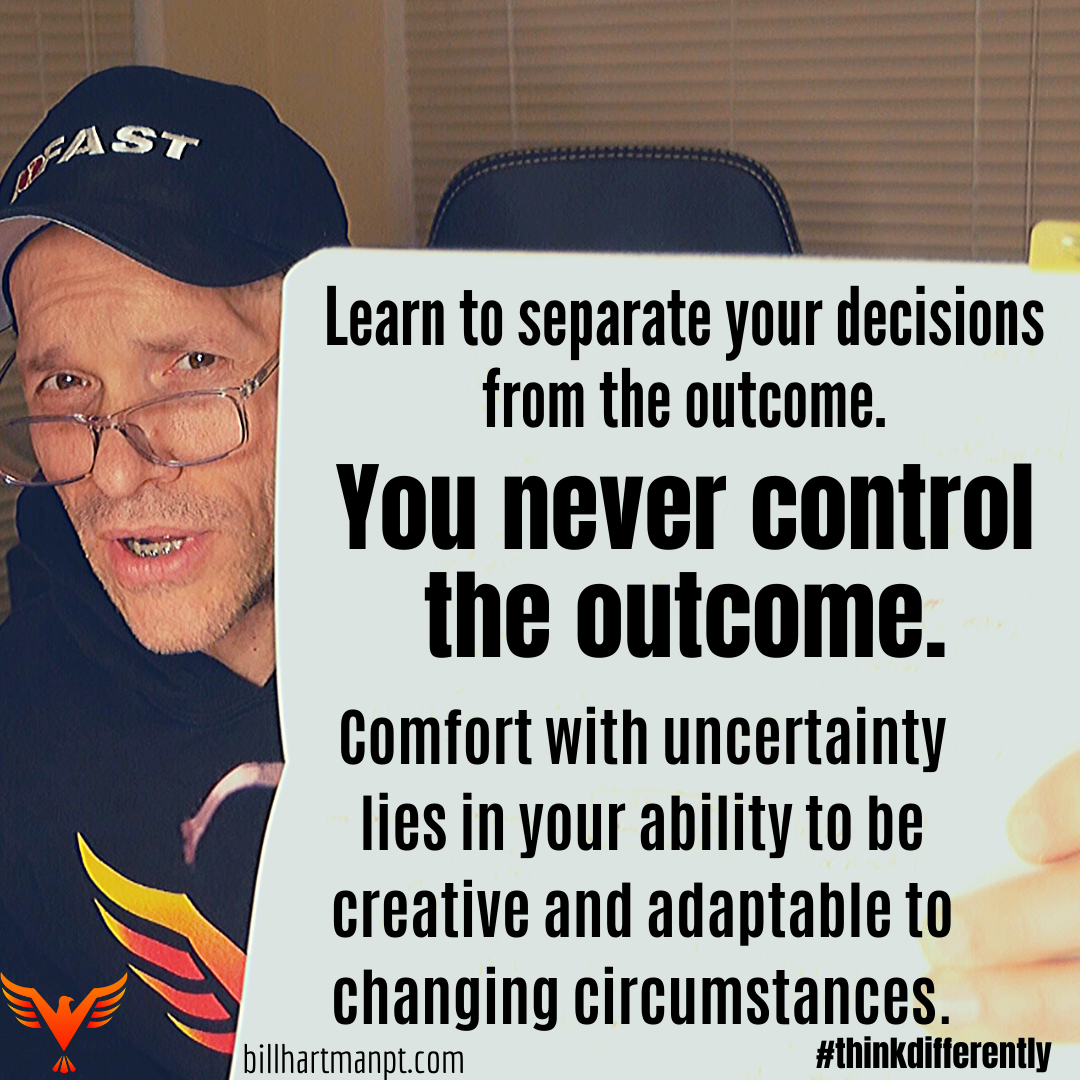
    What you need to recognize is that you can make the best possible decisions and still have an undesired outcome.

    Let’s say you have to make an important decision.

    There’s a 75% chance you’ll have the desired outcome.

    There’s also a 24% chance that you’ll have an undesired outcome (there are many possibilities of undesired considering there may be only one desired outcome).

    You take in as much information as you can. You filter it through several models to determine the best possible decision you can make.

    If you get what you intended, you made a good decision.

    If you get what you did not intend, you made a bad decision.

    Right?

    Wrong.

    Even though the probability of the undesired outcome was much less than the desired outcome, there was still a 24% chance that you would not get what you wanted.

    Here’s what I want you to realize…

    This situation exists in EVERY decision you make even when you may not recognize it.

    This is why it’s so important to reframe failure or bad outcomes. There are influences that you cannot control that determine what happens after we make a decision and take action.

    Spending time beating yourself up over a decision is time (insert “life”) wasted.

    The best course of action is to make the next decision based on the new information (aka the outcome from the last decision).

    identify > adapt or innovate > overcome

    Zero self-judgment. Zero time wasted. Next!

    SIG

    Find Bill:

    Instagram

    Facebook

    Twitter

    LinkedIn