Author: Bill

  • Beyond the Norm

    I recently contributed to a little project that Leigh Peele put together.

    It’s called Beyond the Norm: Advanced Questions for Advanced Trainers and Nutritionists.

    Contributors include:

    Lou Schuler
    Mike Robertson
    Jonathan Fass
    Alan Aragon
    Tony Gentilcore
    Geovanni Derice
    John Izzo
    Jimmy Smith
    Robert Dos Remedios
    Chris Mohr
    Leigh Peele
    and Me!

    This isn’t your typical Q & A and it answers a lot of very specific questions and progression dealing with your post-workout nutrition (not what you think) as well as dealing with hip/pelvic/shoulder issues.

    Get from Leigh Peele by signing up for her newsletter.

    Bill

  • Building Young Champions

    You may or may not know that I sit on the Board of Directors of the International Youth Conditioning Association (www.iyca.org).

    If you’ve got kids in athletics or work with kids in athletics and you’re not involved with the IYCA, it’s time to get involved.

    My buddy and Executive Director of the IYCA, Brian Grasso, was recently featured in this week’s Newsweek. You can read a part of the article at the link below:

    http://www.msnbc.msn.com/id/19114130/site/newsweek/page/0/

    At minimum, every coach, teacher, or parent with athletic children should own a copy of Developmental Essentials: The Foundation Of Youth Conditioning and certainly every coach should be certified as a Youth Conditioning Specialist. You can read a sample of the text at the IYCA website as well.

    Bill

    P.S. My good friend Alwyn Cosgrove is celebrating his Rebirthday. If you’ve been holding off on getting his top-selling Afterburn, the Bodyweight Training DVD, or any of his martial arts training programs, now’s the time to get them. For the next 24 hours, you get free shipping anywhere in the world.

  • Hurdle Mobility Drills

    When it comes to developing hip mobility, hurdle mobility drills typically fall way short of the intended goal.

    Case in point…

    I have 5 athletes of varying sizes training together and one set of hurdles set up for step-overs and duck-unders.

    (Smart guys don’t give it away… just wait for it…let the others catch up)

    The assumption must then be that my bigger, taller athletes have much greater general mobility than my smaller, shorter athletes for duck-unders and my shorter athletes have greater hip mobility for step-overs, right?

    Wrong.

    One size does not fit all, and it usually results in some form of compensation in the lumbar spine and pelvis rather than an increase in hip mobility.

    I’m sure you’ve seen it.

    Big guys ducks under the hurdle and it ends up looking like a dog taking a dump in the back yard as he rounds his back to get under the hurdle rather than utilizing hip flexion (that he doesn’t have a sufficient quantity of to perform the task correctly in the first place).

    The opposite is also true.

    Try to step over a hurdle that is too high and the pelvis must be tilted posteriorly to get the foot up high enough for clearance. This also promotes reduced hip extension on the support leg.

    For those of you who regularly perform the Functional Movement Screen or a Klatt test you’ll see this technique quite often during your assessements of those who lack hip mobility.

    Why reinforce bad mobility during training as well as methods that can promote back injury over time?

    At best, with the optimum, individualized hurdle height, hip mobility can be reinforced with hurdle mobility drills but not improved.

    For that use other effective drills that don’t result in injury potentiating technique.

    Bill

  • Max-Out Radio

    Mike Roussell and I had a great discussion on the latest edition of Max-Out Radio.

    Topics covered:

    Overhead lifts
    Bench pressing
    The 20% Rule
    The easy way to use Inside-Out: The Ultimate Upper Body Warm-up
    Some of the things I’m doing with training
    and more.

    Check it out.

    Bill

  • Neck Training

    Neck Training

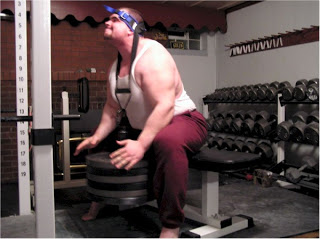
    Here’s a pic I got from Jim “Smitty” Smith from the Diesel Crew.

    I find it interesting that so many neglect direct neck training considering how many neck pain patients I see with significant neck muscle weakness.

    It’s not just for athletes any more.

    Now I’m certainly not implying that everyone needs to do their neck training with six 45 pound plates on a regular basis, but most can benefit from some regular neck strength work and including range of motion and mobility training.

    Especially women. Women, in general, have smaller neck muscles and heads that may weigh more than men. (No, not because they have bigger brains, but rather because they have more hair…sorry girls). While I don’t have hard stats to back this up, I’ve no doubt that a majority of the overuse and traumatic neck strain patients that I see in my clinics are experienced by women.

    Athletes are especially negligent in regard to neck range of motion training in favor of strength work. You’ll be hard pressed to find a football player, wrestler, or mixed martial artist who doesn’t want more neck strength, but ask them about how they’re developing their neck range of motion and you’ll often see a puzzled look on their face.

    Certainly the strength component is important, but in many cases of neck injury, the injury occurs when the neck is driven to end range of motion and beyond. Just like any other joint, a little flexibility reserve in the neck goes a long way.

    Here’s some wrap-up thoughts…

    1. Train your neck

    2. Include range of motion and strength training

    3. Improve strength at the end ranges of motion

    4. Avoid prolonged, repetitive, or aggressive neck flexion (forward bending)

    5. When training the anterior neck musculature, press the tongue to the roof of your mouth

    6. Train the neck at various speeds and loads to increase strength and power

    7. While some isolation training is acceptable, incorporate neck loading into full body exercises. (but that’s another article)

    Bill