Author: Bill

  • The REAL “Rufus” and IFAST is Top 10 in Men’s Health Magazine

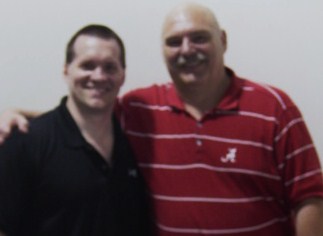
    Me and Grant "Rufus" Gardis
    Me and Grant "Rufus" Gardis

    We had a very special guest this week at Indianapolis Fitness and Sports Training.

    Grant “Rufus” Gardis came by for visit. Yes, THAT “Rufus”. The one from the “Rufus” Complex in Inside-Out:  The Ultimate Upper Body Warm-up.

    Rufus is an outstanding Olympic weightlifting coach in the Indianapolis area who works primarily with middle school athletes from all sports. I hope these kids appreciate and take advantage of his vast knowledge of weightlifting and athletic development as you’ll not find a better coach.

    While it was initially a social call, conversation quickly turned to talking training. Rufus even ended up working with our intern and a couple clients on their power clean technique. It was truly remarkable to see how quickly their technique changed for the better.

    As a friend of IFAST, Rufus has an open invitation to visit the gym any time, so if you see him, make sure to introduce yourself(he doesn’t bite).

    Indianapolis Fitness and Sports Training (IFAST) is Top 10 Gym

    Pick up a copy of the September 2009 issue of Men’s Health Magazine to check out their list of Top 10 gyms in the country. You’ll see that IFAST is on that list. Not bad for our first year in business. We just celebrated our first anniversary and we’re making some serious impact in the fitness and sports training industries. We’ve had clients from Chicago, Michigan, Florida, California, New York, Missouri, Bulgaria, and even two from Japan. Throw in some of the most serious fitness enthusiasts and top athletes in the area and you’ve got the best gym in Indianapolis and one of the Top 10 in the country.

    Bill

  • What are you willing to do to succeed?

    I got an email from Pete Monchek today.

    Pete’s a distance client as is his daughter Maia.

    He wanted to tell me that Maia was just named to the First Team All-State Softball Team in California.

    Just to let you know how good she really is…on the season, Maia lead the team offesively in almost every statistical category with a .550 batting average, 55 hits, including 13 doubles, 5 triples, and 3 homers. She drove in 45 runs and scored 42 herself.

    She’s going to be attending my alma mater, Purdue University, on a softball scholarship proving that she’s also a smart one (she has a 3.9 GPA as well).

    Pete sent me the email at 11 PM California time. He sent it because Maia was busy. She was finishing her workout.

    What are you willing to do to succeed?

    It’s interesting how some athletes are put down for relying on their obvious talent. Those who are critical of others successes never see the hours of work that many athletes put in just to make it look easy.

    Maybe the criticism gives people an excuse. The excuse not to do the hard work necessary to succeed.

    You too can be successful. Just quit making excuses. Stop comparing yourself to others. Take responsibility for where you are now and do the work to get you to where you want to be.

    Bill

    Yesterday’s training:

    60 min of The Dark Knight at 131 bpm average
    Hip mobility

  • Self-ankle mobilization to increase dorsiflexion

    If you’re having anterolateral ankle pressure or pain with dorsiflexion, give this mobilization a try.  We’ve used this a lot in the last week at IFAST and have seen some outstanding results.

  • Peeking (not peaking) at my training, subjective readiness, and joint mobilization

    It was a good day at the gym today.  Everyone that came in was feeling good and putting out a great effort.  I even got a session in at IFAST.

    I’ve been working on some foundational things like developing my cardiac system and my ability to produce energy locally in the muscles as well as addressing some mobility issues in my hips.  This is the kind of work that really isn’t much fun, but it will set me up for the more intensive training to come later.  It screws with your head a bit because, as you’ll see some of this programming is easy from an effort standpoint, but it can challenge your mental toughness.

    Sled drags warm-up
    followed with lower body mobility

    Subjective readiness:  7/10
    forgot my heart rate monitor

    Safety squat bar (SSB) step-ups to just >=90 degrees
    95 x 6, 135 x 3 x 6
    SSB Squat to box just below parallel
    225 x 6, 275 x 6, 305 x 6
    SSB Tempo squats
    135 x 30 sec x 3 on 60 sec rest
    SSB deep quad dominant split squat
    135 x 2 x 5

    Sub jective level of effort 7/10

    3 hours later 30 min of LISS aerobic work at 120 bpm.  This is to ultimately improve recovery and I’ll be doing it more frequently.  Intensity is so low that it won’t impact any other aspect of programming, but I’m expecting to see some improvement in sleep as I adapt.  It is horribly boring, so I watched a bit of Ironman to occupy my brain.

    All in all, not a bad session.  Still felt challenged from an energy standpoint which brought my level of effort down to a 7/10.  Nothing was to failure and I did’t really have any hip pain during training.  It did stiffen up a bit after cooling off a bit.

    Subjective readiness

    Subjective readiness is a measure of how ready I feel for training after warming-up.  It will vary depending on sleep patterns, stress (mental and physical), nutrition, state of recovery, etc.  It’s a good measure to allow you to make programming changes on the fly.  For instance, if you normally get 7 hours of sleep and wake at 6am, but last night you got 5 hours and woke at 5am, you may not feel as good and not as ready as you should be for an intensive training session.  If you still rate your readiness at a lower than normal level (it varies depending on the person), you can effectively adjust your training for that day to prevent excessive loading that may slow or even halt progress.

    I do recommend that you warm-up first as a little activity may actually improve your rating and level of readiness.  I’d also track this measure before every training session to allow you to establish your own typical trends as to how your react to certain intensities and loads.  I tend to use <5/10 as a cut-off for continuing with a regular session or just doing some light recovery work.

    Ankle mobilization

    A lot of coaches will use an active mobilization to improve ankle dorsiflexion as part of their preparation for training.  I’ve had a bit of issue myself in my left ankle, but using Mulligan’s mobilization with movement techniques help quite a bit.  Problem is that it’s damn awkward to try to mobilize your own ankle when a skilled practitioner is not around. 

    I was messing with a technique that I’ve recently started using on myself with a couple clients this morning.   They had some rather significant improvements and were pretty pleased with the result.  It was also quite easy for them to pick up the technique.  I have no idea if anyone else has used this method before, so I’m going to create a video and pass it around to some people and have them test drive it themselves.  If it goes well, I’ll try to post it for all to use themselves.

    Have a great Independence Day!

    Bill