Recovery days are just as important as kick ass workout days. Yesterday was a hard “Arm Day” (chins, rows, and close grip fat bar floor presses) at IFAST, so today is a day off.
To help you relax, here’s a little bit of Chickenfoot to lead you into a productive weekend.
So why the concern over having greater hip and core strength in the cases of athletes with femoral anteversion?
There’s evidence that femoral anteversion results in a decrease activation of the gluteus medius and VMO. There’s also evidence from simulated hip modeling that the hip abductors need to increase force output to maintain a level pelvis during activity when the distal attachment of the hip abductors is positioned more anteriorly as in the case of femoral anteverion. This will then potentially affect lower extremity alignment and stability in the frontal and transverse planes.
The end result is greater potential for non-contact knee injuries. As femoral anteversion is more prevalent in females than males, and considering that the incidence of serious knee injury is higher in females than in males, it stands to reason that developing greater hip and core strength in your female athletes as well as all athletes with femoral anteversion is essential.
Here’s a video of Craig’s Test that we use in our assessments at IFAST.
Position the athlete prone. Flex one knee to 90 degrees. Rotate the hip internally and externally while palpating the greater trochanter until the trochanter is most prominent laterally. Measure the hip rotation angle at the point where the trochanter is most prominent. Norms for males is 8 degrees of internal rotation, females up to 14 degrees. Anything greater than 15 degrees would be considered excessive.
By now you should have a general understanding that having good hip mobility is important for health and to maximize athletic performance.
Loss of hip extension has been shown to accelerate degenerative changes in athletes as young as 17 years old. A loss of hip internal rotation alters normal hip proprioception and makes it difficult to effectively stabilize the hip.
When you’re screening your athletes’ hip range of motion you may come across some athletes that present with excessive femoral anteversion.
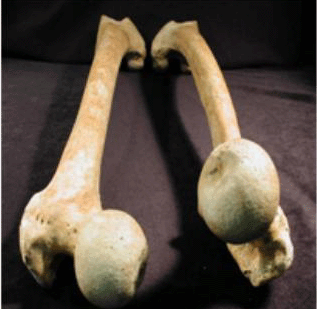
Femoral anteversion is the angular difference between the axis of the femoral neck and the transcondylar axis of the knee. In males, it’s typically about 8 degrees of anteversion and in females about 14 degrees. In the photo, the femur on the left is considered normal, and the femur on the right shows excessive anteversion. You’ll typically use Craig’s test to determine the degree of femoral anteversion, however, if you aren’t trained to use Craig’s test, you can get a good idea from assessing hip rotation in prone.
Hip internal rotation of 70 degrees would be considered abnormal and may indicated excessive hip anterversion. You’ll also find a loss of hip external rotation.
Because this is a structural adaptation, the rotation is not something that will change with typical hip rotation mobility exercises and attempting to do so will only result in injury. If you should have an athlete with excessive hip internal rotation as in the video, developing a stronger core and glutes is essential.
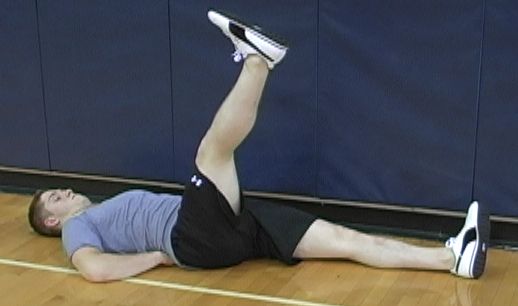
In the Assess and Correct DVD it`s demonstrated testing hip and knee flexion with the hands under the lower back. In the leg raise test in FMS I think, if I remember correctly, that this is not done. Is this because of trying to minimize posterior tilt, or what?
I can’t speak for the FMS, but your thought process is correct. In the Assess and Correct DVD’s, we’re using an approximation of neutral spinal alignment during testing and exercise performance. Placing your hand behind the lower back allows you to monitor your lumbar lordosis to prevent substituting pelvic tilt/lumbar motion for hip motion. Without monitoring, you may get a false positive or false negative for your hip testing.
The general rule is that you should be able to slide your hand under the lower back to your knuckles (metacarpophalangeal joint). If you can’t get your fingers under the lower back, you’re flattening the lumbar spine too much. If your hand slides under too far, your lumbar lordosis is excessive.